There is this famous saying that we are all made of stardust. Though some of us know the reason behind it, most of you wonder why and how! Here’s the reason!
It all began 13.8 billion years ago with the Big Bang. Right after which the tiny particles like hydrogen and helium bounded together to form super dense and cold molecular clouds e.g. Nebulae (the denser region of a molecular cloud). They have an average density of 100 to 300 molecules per cubic centimeter with an internal temperature of about 7 to 50 degrees Kelvin. Based on how dense the cloud is, it has two types – Giant Molecular Clouds (GMC) and Small Molecular Clouds (SMC).
Low-mass stars are formed in SMC’s and the formation of high-mass stars are only possible in LMC’s. The sources said that the cloud which has mass above the Jeans mass, experiences some irregularities like gravitational or magnetic disturbances in the density of the clouds causing gravitational force that pulls up the gas molecules together. As the molecules get together there will be kinetic energy and as a result of which their temperature increases. As the temperature abundantly increases, the molecular cloud separates into many smaller clouds in a cluster and each of which will eventually become a separate star cluster.
The separated cloud now begins to rotate faster to conserve angular momentum because it’s core collapses faster than its outer part. When the temperature of the core reaches 2,000 degrees kelvin, the hydrogen molecules break into hydrogen atoms. Gradually, the temperature of the core reaches 10,000 degrees kelvin and now it starts to look like a star and that’s when the nuclear fusion reaction begins. When it collapses to about 30 times the size of our Sun, it becomes a protostar. When the pressure and temperature in the core is high enough to sustain nuclear fusion, the outward pressure acts against the gravitational force. At this state, the core of which becomes the size of our Sun. The dust which is remaining forms like an envelope surrounding the star with high temperature and glows brightly emitting the infrared spectrums. In this situation, the visible light emitted by the star cannot penetrate the envelope as the temperature is high in the surface. Eventually, as the fusion reaction continues in the core, the radiation pressure from the star blows away from the envelope and the baby star begins its evolution.
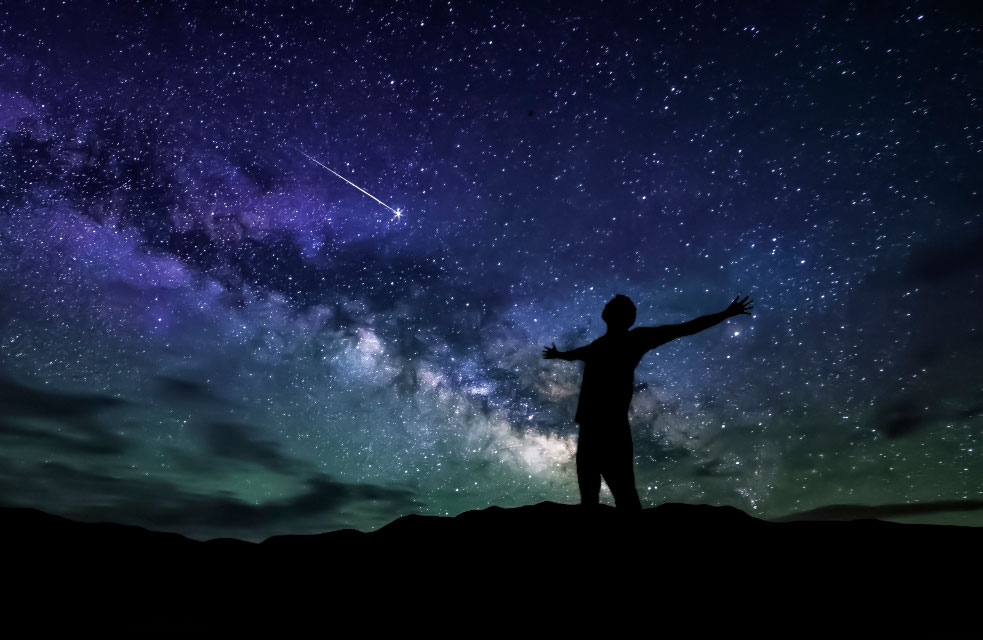
Not just stars are formed in GMC’s and SMC’s, it’s the planets too that originate from the clouds. So, next time you are out there star gazing, just remember that you are one of those!!
References:
https://www.scientificamerican.com/article/how-is-a-star-born/
 StarDustWaves
4 thoughts on “STAR FORMATION”