
Most of us, as a kid, we find thousands and thousands of sparkling things when we look up at night. We call them Stars. We have wondered them with so many questions: Why is it hanging up there? What’s in there that makes it so sparkly? And most of all, the question ‘How did everything begin with a star?’
Generally, the basic elements required for star formation in an interstellar medium is hydrogen and helium. Not everywhere in space we could observe these elements. It is in those regions, where there is an accumulation of interstellar gas and dust is present, star formation could be possible. This region in an interstellar space is known as Molecular clouds. Mostly, the high mass stars are formed in the denser part of molecular clouds known as Nebula.
Stars usually form inside the cloud, once the formation starts, their light illuminates the cloud, making it visible to us. The luminosity of Nebula is about 85 million times brighter than our very own star ‘The Sun’. There are five general types of Nebulae:
- Emission nebulae
- Reflection nebulae
- Dark nebulae
- Planetary nebulae
- Supernova remnants
Emission nebulae are clouds of high temperature gas. The atoms present in the cloud are energized by UV light gathered from a nearby star and as they fall back into lower energy states, they emit radiation. They are also notified as H II regions, because they are mostly made of hydrogen. Emission Nebulae are usually appearing in red. The best example of emission nebula is Orion Nebula
Reflection nebulae are indeed clouds of dust that simply reflect the light of nearby stars. Blue light scatters easily, therefore reflection nebulae are usually appearing in blue. Example: Pleiades. Emission and reflection Nebulae are often seen along and together they are referred to as diffuse nebulae.
In some nebulae, the region where the star formation occurs can be so dense and thick that light cannot get through. They are called as dark nebulae. Example: Horsehead Nebula
The nebulae which results from the death of the star is planetary nebulae. When Red supergiant stars get very old and have burned through its elements and no longer sustain its own fusion reaction, the star’s gravity collapses and its core gets heated up producing a stellar wind that lasts for a few thousand years and blows away the outer layer of the star. Now, the remaining core remnant heats the gasses which causes them to glow. This type of nebulae is so called ‘planetary’ because it appears as a gas giant planet through a telescope. Example: The Ring nebula
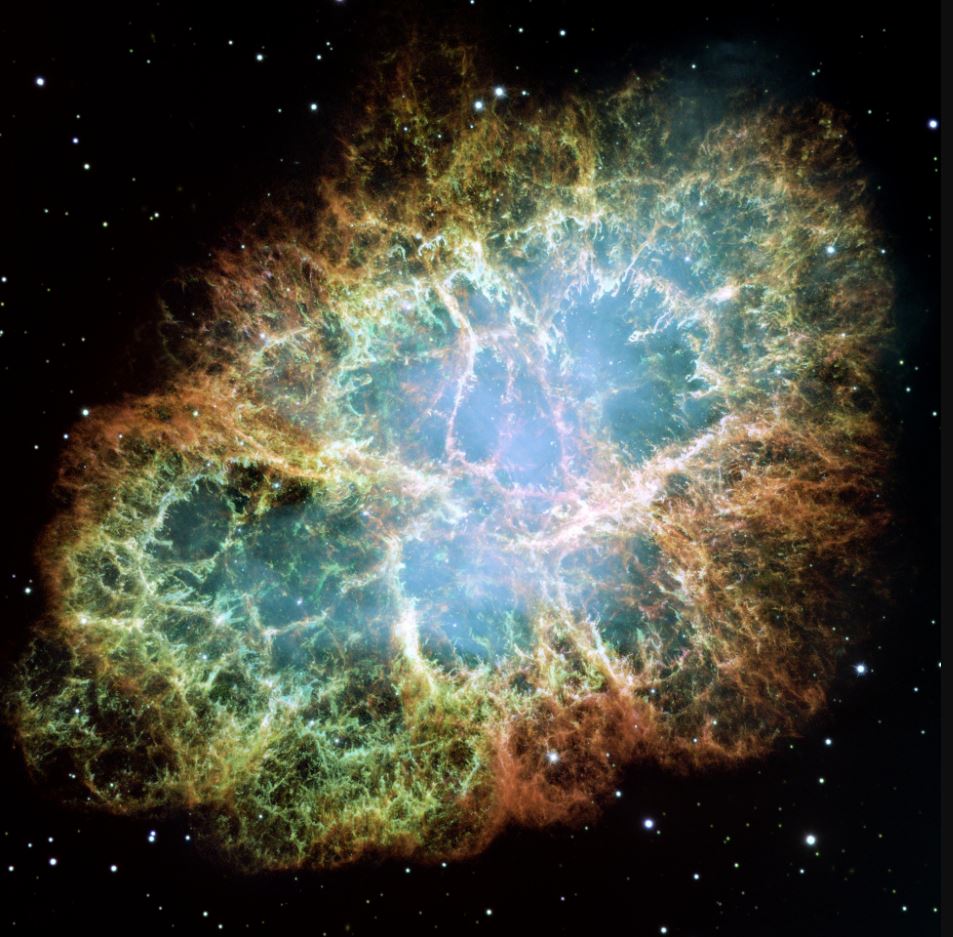
For the mass of a star whose mass is greater than 1.4 times the mass of the Sun, runs out of fuel and collapses, an enormous shock wake sweeps through the star at high speed, sweeping away various layers and leaving a core called neutron star and an expanding shell of matter called supernova remnants. This type of supernova’s shock wave is more violent than stellar wind that results with the end of a low mass star. As the ejected remnant spiral towards the neutron star at the speed very close to the speed of light, they emit a radiation called “synchrotron radiation”. This ionizes the outer filaments of the nebula causing them to glow. Example: Crab nebula in Taurus (M1). The light of the inner core is from synchrotron radiation, while the outer filaments glow in many colours due to the emission of many gases.
Finally, there are millions and millions of nebulae of these types in the universe. The largest nebula can be observed with our naked eye, looking like black or darkened patches in the Milky Way.
Some of the well-known nebulae are listed below:
TARANTULA NEBULA
It is the largest known emission nebula (H II region) located in our neighboring dwarf galaxy called Large Magellanic cloud (LMC). Tarantula nebula is also known as NGC 2070 nebula or 30 Doradus. It is 1000 light-years in diameter. There are over half a million times the mass of the Sun in the Nebula.
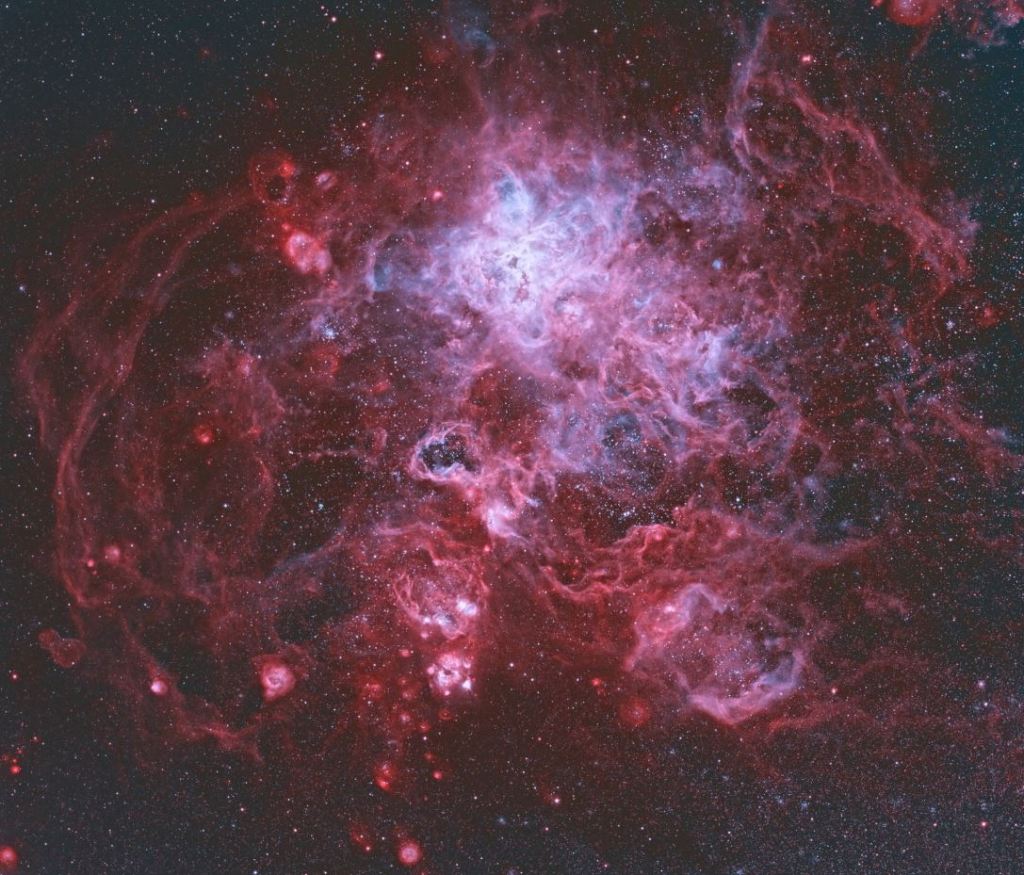
Within this Nebula, stellar winds and supernova shocks from massive stars o young clusters energize the nebular glow and the shape as spider’s filaments. Around the Nebula are the other regions where the formation of young star clusters happens.
ORION NEBULA
The Orion nebula also known as Messier 42 (M42) blazes brightly in the Orion constellation. It is only 1,500 light-years away, making it the closest large star-forming region to Earth and giving a bright magnitude of 4. M42 can be spotted by naked eye just below Orion’s belt.
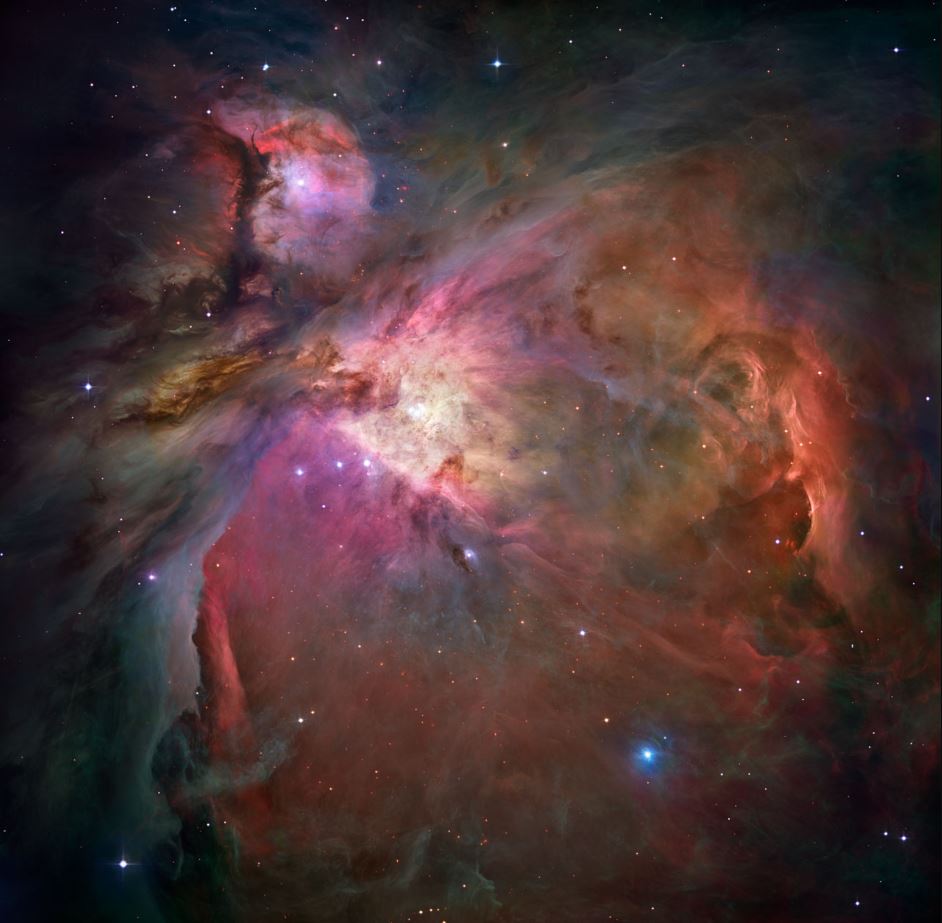
The orange color in the image indicates hydrogen, green represents oxygen and red indicates sulfur. The observations are made using IR light.
PLEIADES
Pleiades or Seven Sisters (M45) is the most famous open star cluster in the sky. The star cluster can be seen 400 light years away in the constellation Taurus. The bright stars in Pleiades are evident even in light-polluted cities without even using any binoculars.
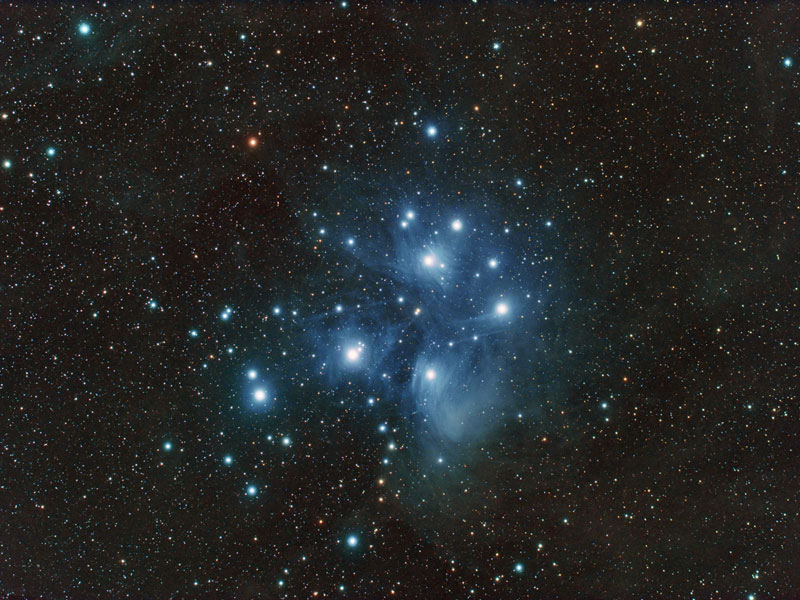
In the above picture, the blue color shows that it is a reflection nebulae.
HORSE HEAD NEBULA
It is one of the most famous nebulae on the sky which is also known as Barnard 33. The horse head feature is dark, because it is accumulated with dust clouds that lie in front of the bright red emission nebula. Since, the structure is like a horse’s head, the nebula got its name.
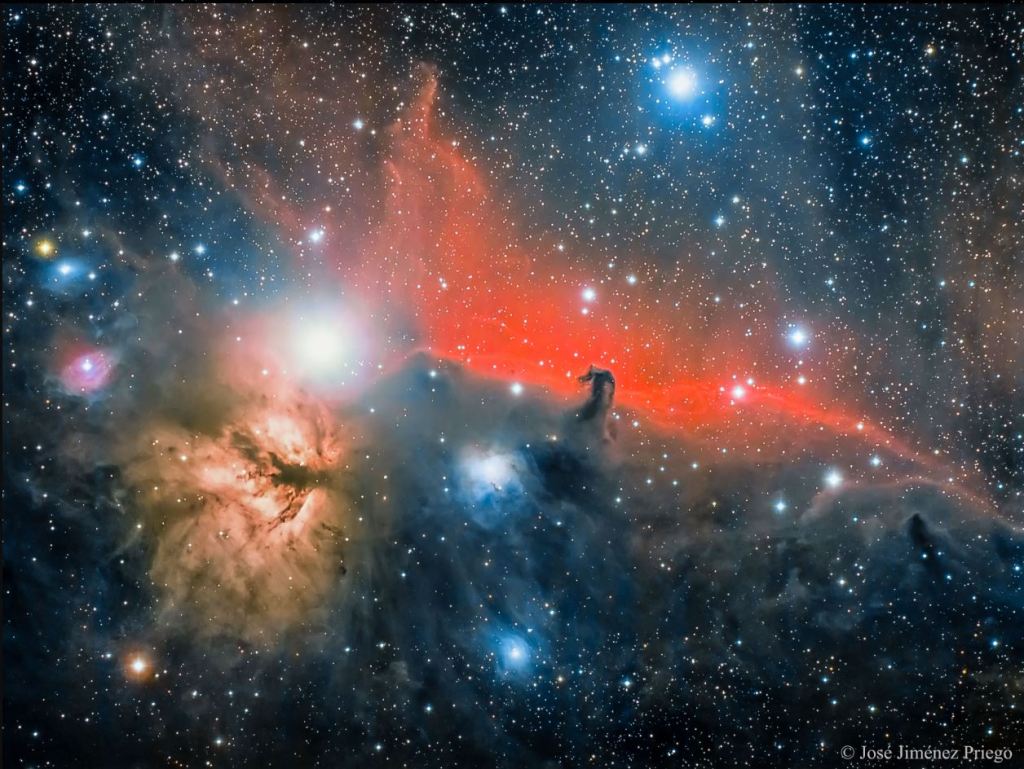
In the image, left is the orange filaments are Flame nebula, that consist of dark dust. Just below the Horse head nebula is a blueish reflection nebulae that reflects blue light from the nearby stars.
RING NEBULA
Ring nebula(M57) is a well-studied example of Planetary nebula and is located to the south of the bright star Vega. The glowing strings represent the gases expelled from the outer layers of the dying star. Almost, 10 – 20% of planetary nebulae are bipolar (i.e.) the nebula characterized by two lobes either side of a central star. M57 also falls under this category. Ring Nebula is about one light-year in diameter.
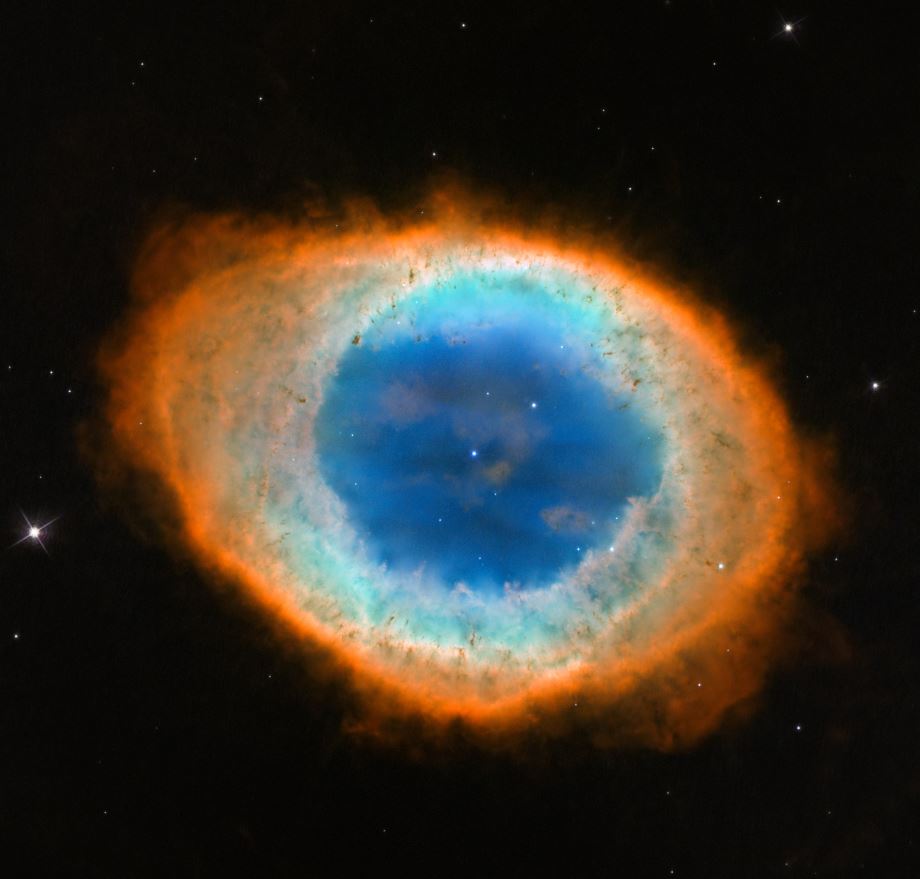
In the image, the tiny white dot in the center is the star’s hot core called white dwarf.
CRAB NEBULA
Crab nebula (M1, Taurus A) is a supernova remnant is located in the constellation of Taurus is about 11 light-years across and is expanding at a rate of 0.5 % of the speed of light. It is filled with mysterious filaments that are tremendously complex. One specialty of this type of nebula is that there is a crab pulsar (a neutron star that rotates and emits radiation from gamma rays to radio waves) present at the center of the nebula which rotates about 30 times each second! The lifespan of a crab nebula is about 10 light-years.
 StarDustWaves
6 thoughts on “NEBULAE”