
Star formation occurs every second in nebulae resulting in millions and millions of stars out there. Every star has its own identity. So, on what basis do the astronomers categorize the stars? How do they end up in a particular name?
Astronomers have a list of characteristics, based on which they categorize the stars.
LUMINOSITY
In the early twentieth century, Astronomers compared the color of the star to make plots. They took a spectrum of thousand stars and separated them into classes in order of decreasing temperature. Such as OBAFGKMLT, the hottest stars are class O, while the coolest stars are class T. For example: Our star, “The Sun” belongs to the class G. Two astronomers, Ejnar Hertzsprung and Henry Norris Russell, started to wonder, what it would show if all the stars are compared by their luminosity and plot. And they found that 90% of the stars fell into a narrow band they termed as ‘main sequence’. This plot is known as Hertzsprung-Russell (H-R) diagram.

Further, astronomers divided each letter into ten categories (i., e) from 0 to 9, with 0 being the hottest and 9 being the coolest. For example: O0 is the hottest star and O9 is the coolest. Therefore, A1 is hotter than A2, and A9 is hotter than F0 star. Also, the stars were ranked in six magnitude classes, from 1 to 6. Lower the magnitude, brighter the star is. For example, Sirius which has the magnitude of -1.44 is the brightest of all stars.
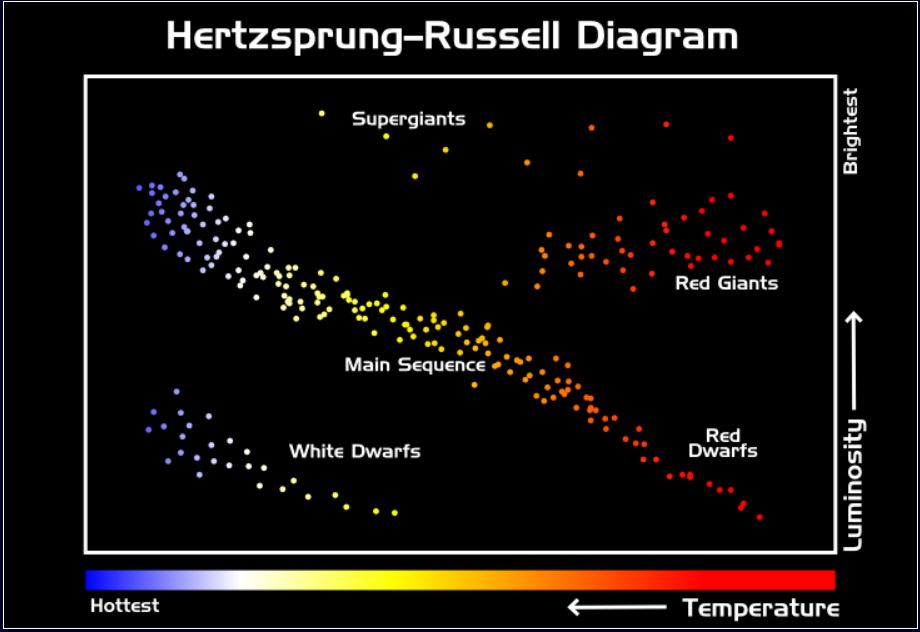
The roman numerals are described to denote the class of a star type in common. Such as I as Supergiant; II as Bright Giant; III as Giant; IV as Subgiant; V as Main Sequence Dwarf; VI as Sub-dwarf; VII as White Dwarf. Example: The Sun is categorized as a G2V star, which lies in the main sequence.
The star’s luminosity depends on its mass and surface temperature.

MASS AND SURFACE TEMPERATURE
Stars with similar masses may not be with similar size, they differ in density resulting as dependence on their surface temperature. For instance, Sirius B is almost having the same mass of our Sun, but is 90,000 times denser. This brings a huge difference in their surface temperature. The luminosity of a star is proportional to temperature to the fourth power.
BASED ON CONSTELLATIONS
Stars within the known constellations are given their name alpha, beta, theta, gamma, chi, Epsilon, lambda, iota. For example: A single star, ‘Alpha Aquarii’ in the constellation of Aquarius. It is the second brightest star in Aquarius of magnitude 2.94.
 StarDustWaves
8 thoughts on “STAR CLASSIFICATION”