The stars above us may seem to be the same to us. But, do they really remain the same always? No, they undergo transformation from one form into another. Now, what happens to the stars in the main-sequence after all the helium is used up in the core?
For example: The Sun. After all the helium in the core of the Sun is used up, the next stage of the star depends on its mass. Stars with mass equivalent to our Sun simply burn out and swell into red giants, shedding their outer layers into a beautiful Planetary nebulae and leaving the core as a hot white dwarf, a type of a star in which no fusion reaction occurs. A source says that after some years, white dwarfs will eventually stop emitting light and heat and become black dwarfs. Stars in the main sequence, if it has mass less than or equivalent to our Sun, they become White dwarfs.
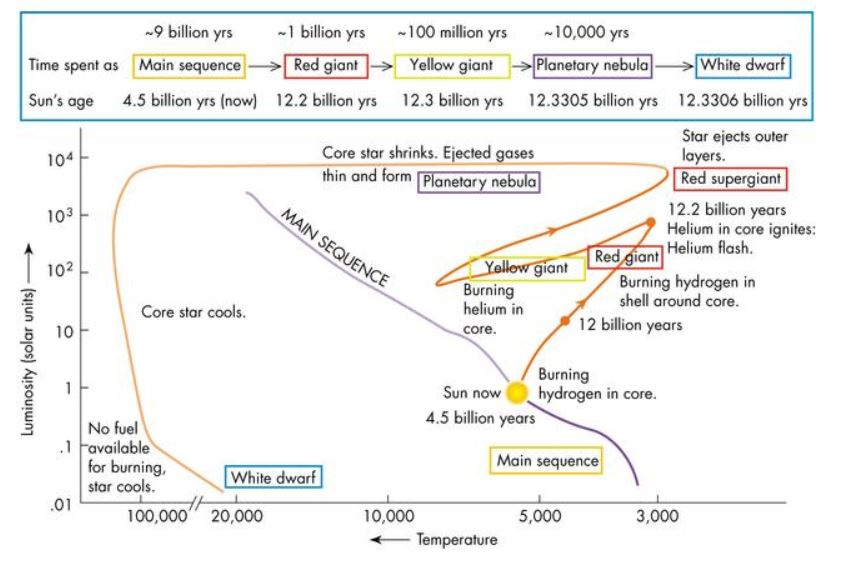
Stars which are more massive than Sun (6 times or even more) become blue giants which will never become a white dwarf. Instead, they burn out their fuel and become red supergiants and end their life by exploding in a violent supernova, leaving behind a neutron star or a black hole.
As you can see, interstellar material can never be said to be totally lost. One way or the other, it is connected to the birth of new stars or planets. This is the cycle of life.
 StarDustWaves
2 thoughts on “THE LIFE OF A STAR”