I guess this is a mandatory article during this period. Being in self-quarantine for almost a week now, made me write this particular one. COVID-19 is something you really need to be precautious about. Take every possible safety measure and try making NO personal contact with others.
Coming back to the article, this morning, I was there in my terrace to see the sunrise. I went up a little earlier, when the sky was dark. And I was seeing the stars above me using my SkySafari application to know the name of the stars, the constellations and the planets(This app is really good. I will mention the application’s link below this article or just click the name. Random space lovers, do check this app). While using this app, I noticed a weird constellation, “CORONA AUSTRALIS”. Today, this constellation rose in the sky by 01.34 am and set by 12.07 pm. People who are in the field of Astronomy would have known about this. But, seeing this constellation literally shook me.
You see, this name “Corona” is now becoming worldwide contagious and people are getting fed up with this virus. Yet, I decided to write something using the word and there is some interesting information I’ve got for you about this constellation, CORONA Australis.
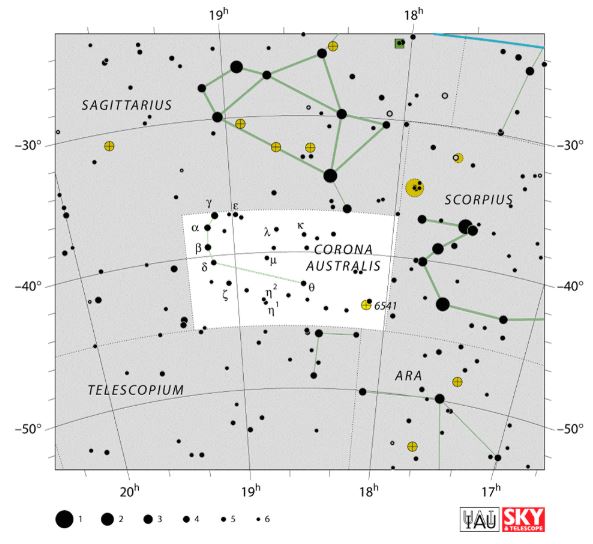
First of all, in the constellation ‘Corona Australis’ or ‘CrA’, the Latin word Corona means “The crown”. But, the stars in this constellation do not look like a crown but more like laurel wreaths. Still, astronomers went by the name Corona. Together, Corona Australis constellation is known as “The Southern Crown” The countries below the Earth’s equator can view this Constellation. And, the countries above the equator can view “The Northern Crown” which is called “Corona Borealis”.
Corona Australis is one of the smallest constellations in the sky that has 6 primary stars and is located 32.6 light years from Earth. But this constellation still has 21 stars visible to the unaided eye. The magnitude of the stars present in this constellation are no lesser than 3.
α CrA (Alpha Coronae Australis) – Star Classification: A2V star with magnitude 4.10. It is 130 light years away from Earth.
β CrA (Beta Coronae Australis) – Class: K0II – type bright giant. This star has an apparent magnitude of 4.117 and is 510 light years away.
ε-CrA (Epsilon Coronae Australis)- This star is 98 light years away from Earth with magnitude 5. This is a bizarre star; it is an eclipsing binary with two similar eclipses that take place with an orbital period of 0.5914264 days. So, every less than 7 hours, you will encounter a faint star passing in front of the bright one that gives us 95% of the light and then the bright one passes in front of the fainter. These are fast spinning stars producing huge amounts of magnetic activity and dark star spots, sharing mass and pulling at each other in just a matter of hours!!
γ-CrA (Gamma Coronae Australis) – It is a F type star with absolute magnitude of 3.73.
θ-CrA (Theta Coronae Australis)- It is a G-type star with magnitude of 4.64 and is about 11 times wider than the Sun.
R Coronae Australis – It is a well-known relatively young variable star with spectral type A5IIev, and is approximately 26.8 light years away from Earth. This star has magnitude of 11.5
This constellation has its own neutron star – RX J1856.5-3754 located at an estimated distance of 400 light years from Earth. It is the closest neutron star to our solar system. This star is believed to have been formed by the supernova explosion of its companion star. It is relatively moving at the speed of 108 km/s and is approximately 14 kms wide.
The neighbouring constellations of Corona Australis are Sagittarius to the north, Scorpius to the west, Telescopium to the south and Ara to the southwest. The meteor shower respective to which will be Corona Australids which are active between March 14th to March 18th and it peaks on March 16th each year. Average of about 5 to 7 meteors per hour can be seen.
Though the word is irritating, it has different meanings in different fields. So, pull everything together (only YOUR INNER-SELF) and be safe.
And yes, the Sunrise was absolutely beautiful. It rose around 05.50 am. It was vibrant. Also, the rhythm made by all those birds chirping and singing softly was the best thing to hear in the morning. The time I spent was very productive, observing and listening to every little thing happening around me was just PERFECT!!
APPLICATION DESCRIPTION:
https://play.google.com/store/apps/details?id=com.simulationcurriculum.skysafari5
There are so many features in the mobile app. Some are: looking for Sun & planet, Moons, the Constellations, Satellites, the Stars, Meteor showers and many more things to look at in the sky. Go check it out and be more amazed during night time!
 StarDustWaves