
As the world is already fighting its pandemic, this article may not give you good news. You may think that the world is recovering from all the pollution made by humans, as the whole world is contributing to save the Earth by doing nothing. But the fact is that ‘It is not!’ Ozone layer depletion occurs every year, mostly in Southern Hemisphere (i.e. Antarctica) and sometimes in Northern Hemisphere (i.e. Arctic region). It wasn’t a big deal after signing the Montreal Protocol in 1987, 197 countries agreed to phase out the chemicals like Chlorofluorocarbons to protect the ozone layer from further damage. Everything was under control.
But recently, climatic change is back with larger effects than usual over the last month. Scientists using the data from Copernicus Sentinel-5P satellite have noticed a strong reduction of ozone concentrations over the Arctic. A new hole that covers at-least 3 times the area of Greenland is seen in the Ozone layer over the Arctic region.
According to European Space Agency (ESA), the depletion of Ozone in the North pole has happened plenty of times in the past. Diego Loyola from German Aerospace Center says “This year has a maximum extension of less than 1 million sq km. This is small compared to the Antarctic hole, which can reach a size of around 20 to 25 million sq km with a normal duration of around 3 to 4 months”
One of the main reasons for ozone depletion in Antarctica every year is due to the combination of frigid temperature and human-made pollution. When the temperature falls down rapidly at the start of Antarctica’s winter, high-altitude clouds form over the South pole. Also, chemicals like Chlorine and bromine including the industrial chemical pollutants trigger reactions in these clouds that affect the surrounding ozone gas.
The Arctic, on the other hand, has more variable temperatures unlike Antarctica so the ozone depleting conditions are not seen often. But this year, powerful winds trapped cold air in ‘polar vortex (a low pressure area that circles a whirlpool of stratospheric winds)’ above the Arctic. This led to colder temperatures. When the temperature is low in the poles, high-altitude clouds form. In this case, the clouds were higher than usual, resulting in destruction of ozone.
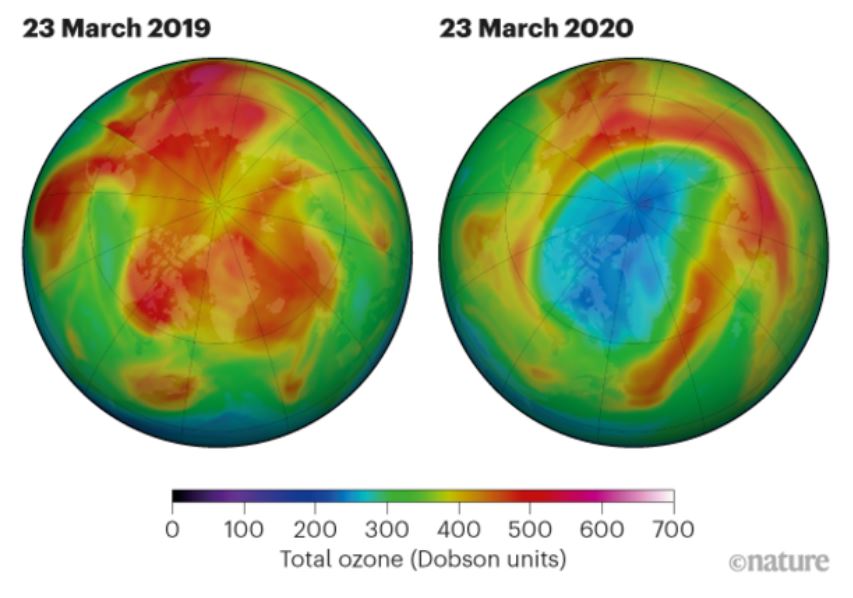
Credit : NASA Ozone Watch
Scientists say that this type of conditions happening in the Arctic is very rare and for the first time, the Arctic experiences this big depletion and believe that the first sunlight over the North pole at the end of polar winter, initiated this unusual strong ozone depletion, causing a hole to form. Also, they expect to heal within a month as temperature gets warmer. This hole is still nowhere to threaten human health.
Markus Rex, an atmospheric scientist at the Alfred Wegener Institute in Potsdam, Germany, says “If it were to drift to lower latitudes in the coming months, it would be difficult to deal with it and it is important to be bit more careful and apply sunscreen to avoid burns”
But, does this depletion in the ozone layer cause atmospheric changes? Definitely, they do affect our atmospheric condition. The effects of colder stratosphere in the North pole surprisingly can show its impacts all the way to the equator affecting tropical circulation and rainfall at lower latitudes.
 StarDustWaves