There are certain facts about Titan that keep us Earthlings fascinated. Titan, one of Saturn’s 53 moons and a second largest moon in our solar system after Jupiter’s Ganymede which is larger by just 2% than Titan. Let’s see why Titan is amazing. Ever since humans started to show interest in searching for exoplanets and other life existence in various stellar places, next to Mars, astronomers and planetary scientists spotted Titan and showed interest in the moon rather than the planet Saturn itself.
Our solar system has more than 150 moons and Titan is the only moon with a dense atmosphere. Well, apart from Earth, Titan is the only stellar body that has liquid including rivers, lakes and seas on its surface. Well, you may think that even Planet Mars has similar traces in it. Yes, you are right. In fact, our red planet used to be a lot wetter than it is today. The sources say that there is a higher possibility than an asteroid slammed into the ocean approximately 3.5 billion years ago, creating a mega-tsunami about 1000 feet high! But now, the surface of Mars is just rocky with canyons, volcanoes, crates and dry lake beds all over the planet. Mars was fun, a few billion years ago!
This is not the case in Titan. It has seas, rivers and even lakes like we have on Earth! Titan is 50% wider than the moon and even bigger than planet Mercury. Titan is 1.4 billion kilometres away from the Sun and 1.2 million kilometers away from Saturn. So, light takes about 80 minutes to reach its surface. Also, sunlight at Titan is 100 times fainter than at Earth due to the distance factor. Several probes have imaged Titan, but only one has visited its surface, the Huygens Lander. The combined Cassini-Huygens spacecraft was launched on October 15, 1997. Huygens separated from the Cassini orbiter on December 25, 2004 and landed on Titan on January 14, 2005. The descent lasted 2 hours and 25 minutes and the lander survived for 72 minutes on the surface of Titan. This is the only landing accomplished on the moon other than Earth’s moon. So, approximately it takes 8 years to reach Titan.
The atmosphere in Titan is 95% nitrogen and 5% methane with small amounts of carbon-rich compounds. When you enter the atmosphere of Titan, the pressure is about 60% greater than our Earth. Means you will feel yourself as if you are 15 meters below the surface of the ocean on Earth. Titan has a weak gravitational pull. The compounds produced by splitting and recycling of methane and nitrogen create a kind of thick and orange colored haze that makes the moon’s surface difficult to view from space. However, these hydrocarbons play the role of sand in Titan’s surface. And methane condenses into clouds that it rains gasoline like liquids.
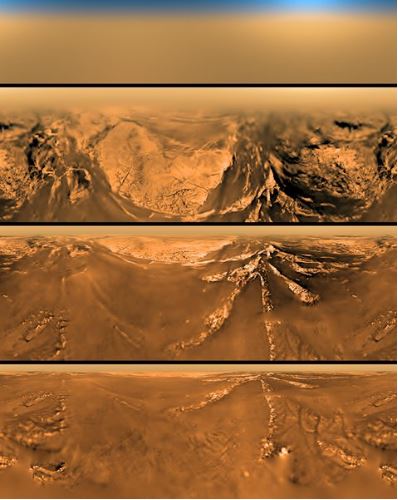
(Image credit : ESA/NASA/JPL/University of Arizona)
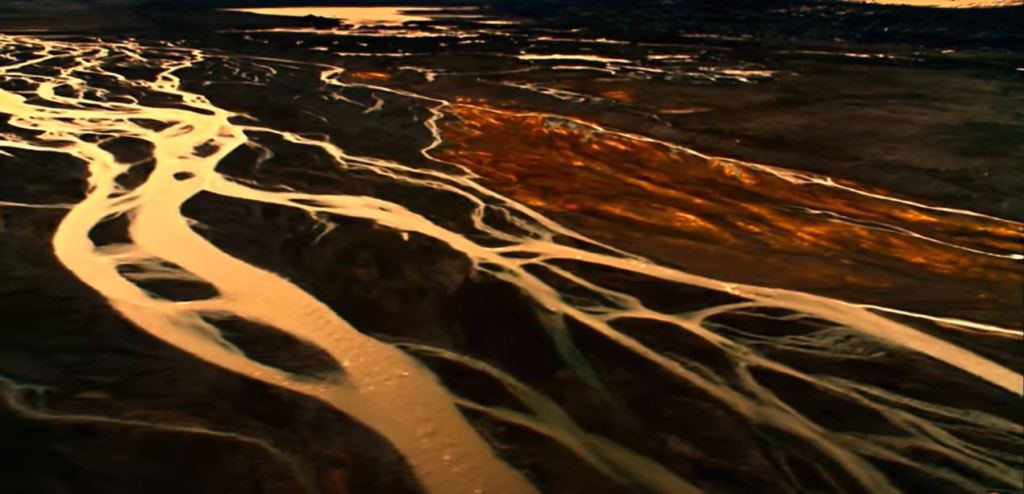
When you reach the surface of Titan, you will experience its temperature about -83 degree Celsius below absolute zero. Titan is the world with liquids in the Northern region. But the liquid present in this moon is “Methane”. If you feel like taking a bath in these liquid methane lakes with a spectacular view of Saturn, I must warn you that you will feel much denser in these lakes than on Earth, also it lacks oxygen. There are more than 50 lakes in Titan and one of the lakes in this moon named Kraken Mare which is 400,000 sq. km which is bigger than our largest lake on Earth, Caspian Sea (82, 103 sq. km). Methane soaks like water into the ground. The rivers of methane flowing on the surface of Titan, its the ocean of Hydrocarbons!

(Credit: NASA/JPL/ESA)
Now, what about volcanoes? On Earth, its molten lava. But with that lower temperature in Titan, will the volcano even eject any hot stuff? Nahh!! What comes out of Titanian volcanoes is a mixture of ammonia and water which allows water to melt at a very lower temperature. If you place your hand in one of these volcanoes you do not have to worry that it would burn you. Instead, it will instantly freeze your hand!
At the equator of Titan, there are deserts which are similar to the sandy hills of Sahara on our home planet. But obviously, their origins are completely different. Unlike Earth, Titan dunes are forged by short, powerful rogue winds. These dunes have an altitude of almost 91 meters. Since we have similarity in deserts, we can identify the pattern of winds in Titan. Researchers believe that the dunes are shaped by short, rapid bursts of westerly wind. Also, the winds on Titan occasionally reverse direction and dramatically increase in intensity due to the changing position of the Sun in its sky.

(Credit : NASA/JPL/ESA)
In conclusion, we evolved life at a very sustainable condition and there in Titan might be a different kind of life forms which adapted in that atmosphere. If they study our environmental condition, they might start to wonder how humans stay on Earth! They will be amazed like we do at them…
 StarDustWaves