
Yellow dwarf stars are much more common in our galaxy. These are medium-sized stars like the Sun. Our Sun is a very good example for a yellow dwarf star. Keeping our Sun, a referral star as one solar mass, the other yellow dwarfs are between 0.84 and 1.15 times the mass of our sun.
The temperature of these Yellow dwarfs are around 6000 degree Celsius. As you have seen in the previous article, the color of a star you see from Earth is not its actual color. On Earth, if we look at the Sun during its sunrise or sunset, it will appear as orange or reddish through naked eye. When viewed during mid-noon, it will be pale white. But what exactly the color of the Sun could be? What we see through naked eye isn’t false, it’s real! We see what our Earth atmosphere let us see!! And that’s due to the nitrogen molecules present in our atmosphere.
Although, if you are in space, a place where no atmosphere is. What could be its color then? It’s WHITE. That’s right, our sun’s peak wavelength color is slightly greenish-yellow and it emits equal amounts of reddish and bluish wavelengths of light.
There are approximately 16 billion yellow dwarf stars in our galaxy. Refer star classification on how the stars are classified in categories. Our star, the Sun is classified as a G2 V star.
- G tells the temperature of a star i.e. 5,000 – 6,000 K
- 2 tells the magnitude of the temperature i.e. from 0 to 9; 0 being the hottest and 9 being the coolest.
- V (the Roman numeral) shows the class type i.e. Our sun is a Main Sequence Dwarf star.
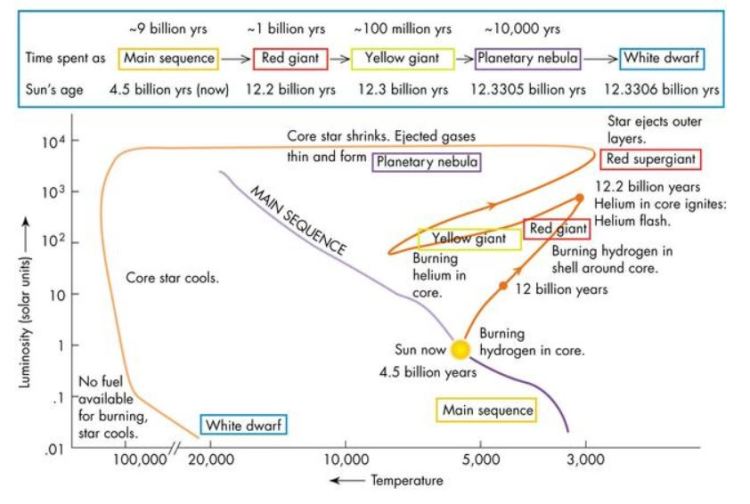
Stars don’t shine forever, do they? So, what happens to the Yellow Dwarf Stars. These stars are currently burning hydrogen in their core and they continue to do so for approximately another 12 billion years. Once every hydrogen element gets converted into helium, it becomes a Red giant. During this stage, the yellow dwarf gets bloated enormously and remains the same for an estimated time of another 12.2 billion years. Then it starts to burn helium in its core becoming a Yellow giant. At this stage, the pressure inside the star starts to get intense. The star ejects its outer layer of gases and becomes a Red Supergiant Star. At this stage, a star runs out of a fuel to burn and blows off its outer layer. These outer layers of gas expand into space forming a beautiful planetary nebula. This nebula will be present in space for an estimated time period of almost 12.3 billion years. Planetary nebula cools down eventually and ends up as a White dwarf.
If you wonder, why these types of stars don’t end up as a black hole or a neutron star. The only answer could be the star’s mass. Only a star whose mass is much greater than our Sun can end up as black hole or neutron star. Stay Tuned to know about those stars which end up like those fascinating stellar objects!!
 StarDustWaves
2 thoughts on “Yellow Dwarf Star 1.02”