“Nature doesn’t form stars in isolation,” said Mark Morris of the University of California at Los Angeles (UCLS), said in a statement. “It forms them in clusters, out of natal clouds that collapse under their own gravity.” Likewise, Out there in Cosmos, there are millions and billions of stars. For these astonishing astronomical objects to form, there must be a region which is so dense and that could hold off the pressure of its own gravity that initiates nuclear fusion in its core. This region in space is known as Nebula. A Nebula is everything but a celestial cloud of gas and dust that gives rise to a star.
To identify these stars easily, Danish Astronomer, Ejnar Hertzsprung called them “giant” and “dwarf” stars. Giant stars being brighter than our Sun and dwarf stars being fainter than our Sun. Also, Ejnar Hertzsprung and Henry Norris Russell developed H-R diagram (Hertzsprung-Russell) plotting their temperature-luminosity ratio.
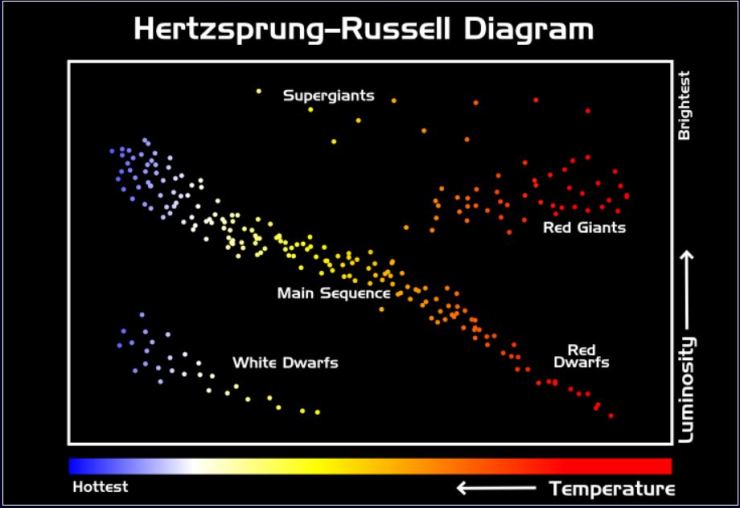
The central region in the H-R diagram is the main sequence stars. The hottest and brightest star falls under this category. Most of these stars are Dwarf Stars and they remain stable for a very long time unlike the other categories of stars. One of the best examples for a main-sequence star is The Sun. But, what is so special about these Main Sequence stars that they remain stable? Based on the process of how a star uses to generate energy, the main sequence is divided into two major parts.
- Upper Main Sequence
- Lower main Sequence Stars
The stars that have a mass greater than 1.5 times of the Sun’s mass (1.5 M☉) are categorized as Upper Main Sequence Star. These stars which have greater mass produce energy by only one type of nuclear fusion i.e. fusing hydrogen into helium. The stars that have a mass lower than 1.5 solar masses (1.5 M☉) are categorized as Lower Main Sequence Star. These stars which have lower mass produce energy by another type of nuclear fusion i.e. fusing Carbon into Nitrogen and Nitrogen into Oxygen and so on. The Lower main sequence stars are more stable than the one in Upper main sequence due to the fission process that varies accordingly. The Upper main sequence stars are still burning Hydrogen in their core. While, the Lower main sequence stars are burning Helium in their core. Our Sun is located on the lower main sequence and is expected to last for 10 to 12 billion years. Any star located on the upper main sequence may only last another few million years and falls into the category of Lower Main Sequence Stars.
Eventually, a main sequence star burns fuel in its core and leaves the main sequence. For the stars having 1 to 8 Solar masses (M☉), it will become a Red giants -> Planetary nebulae -> White Dwarfs.
If you wonder whether main sequence stars can end up as a neutron star or a black hole! Only the stars with its mass above 9 Solar masses to 30 Solar masses (M☉) can become Supergiants -> Supernovae -> Neutron stars / Black holes.
 StarDustWaves
3 thoughts on “Main Sequence Stars 2.0”