
There will always be a cause for every marvelous event that has happened in our universe! Though researchers are still trying their best to find out what could be the cause of the Big Bang, we do know what causes the stars to attain its mass.
For the past several years until 2012, the astronomers made their analysis only on full grown stars. But in the year 2012, astronomer John J. Tobin and his colleagues measured the properties of a newborn star and its surroundings. Determining which they have found that it had only formed about 20% of the matter surrounding it. The newborn star hasn’t even begun its nuclear fusion process. They called this newborn star / young star as Protostar or Young Stellar Object (YSO).
Basically, a protostar represents an early stage in the formation of a star. It is their final formation stage of the mass that decides whether the protostar becomes a star or a planet or with insufficient mass, it can also end up as a brown dwarf star. When the final state of protostar is more than 0.08 solar masses, the star starts burning hydrogen and joins the main-sequence family. When it is less than 0.08 solar masses, it is neither considered as a star nor a planet. So it is categorized as a brown dwarf star.
We also know that stars form inside a very dense interstellar gas and dust known as molecular clouds. These regions in the interstellar medium are extremely cold but not as cold as the Boomerang Nebula. Usually at these temperatures, gasses turn into molecules. CO and H2 are the most commonly present in these interstellar clouds. With this deep cold temperature, gases start to clump together with high densities. When this density reaches a certain point, the formation starts. These regions are very dense that no visible light can pass through. Astronomers use IR and radio telescopes to investigate them.

Credit : http://abyss.uoregon.edu/~js/ast122/lectures/lec13.html
The denser part of these molecular clouds is its core than the outer cloud. When this cloud core collapses under its own gravity, star formation will occur. Their typical mass will be around 104 solar masses in the form of gas and dust. As this core collapses they fragment into clumps around 0.1 parsecs in size and 10 to 50 solar masses in mass. These clumps will then form into a protostar. It takes about 10 million years to complete this whole process.
Once the clump is formed and it is broken free from the other parts of the cloud, it forms its unique gravity and in that case, every clump is considered to be a separate protostar. When it is formed, all the loose gas that is present around it falls into its center releasing Kinetic energy in the form of heat. The nebular disk also forms slowly to become a complete planetary system. Infalling matter gradually increases the size of the protostar by a factor of 100. This results in increased temperature and pressure at the center. At some point, the pressure in the clump stops the infall of further gas into the core making the object to be stable enough as a protostar. After a few million years, the core of the star begins its thermonuclear fusion and the protostar starts producing strong stellar wind that stops the infalling matter from reaching its core. Only at this point, the protostar is considered to be a stable young star.

Credit : http://abyss.uoregon.edu/~js/ast122/lectures/lec13.html
The youngest protostar yet observed is known as Roberta J. L1527 has only about 20% of the mass of the surrounding envelope. Since it is like a newborn star, it’s mass is determined to be about 19% of the Sun’s mass, but it’s volume is spread across nearly 7 times that of the Sun’s. The disk surrounding the protostar is about 180 Astronomical Units (AU) in diameter. And the mass of the disk is small, only about 0.7% of the Sun’s mass. The total mass of the envelope is approximately 5 times the mass of the protostar itself. This protostar is just 300,000 years old.
Credit : http://www.ukaff.ac.uk/starcluster/
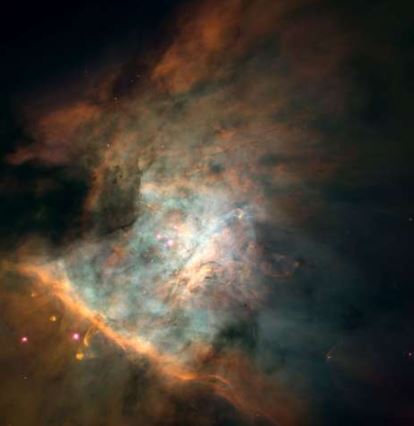
This image shows the center of M42 where Astronomers have identified nearly 700 young stars in this 2.5 light-years wide area. This image is a mosaic combining 45 images taken by the Hubble Space Telescope.
Credit : NASA, C.R. O’Dell and S.K. Wong (Rice University)
 StarDustWaves
♥️♥️♥️♥️
LikeLike
True that “a cause for every marvelous event” !
LikeLike