In the last segment of star series, we have seen the birth of the star i.e. newborn stars known as Protostars. In this segment, let us see how stars end up? I mean, they don’t live forever with the same structure and the properties. But once their structure disintegrates, their matter still continues to exist in this universe.
How a star could end up totally depends on the mass of a star. When a protostar has finally attained its stable mass, according to the mass, the star will be considered as a dwarf star or a main sequence star or even a giant star. When the protostar exceeds 0.08 solar masses it will be categorized as a main sequence star and if it has less than 0.08 solar masses, it is considered as a brown dwarf star which is insufficient to carry on the fusion process.
Neutron stars are very small when compared to the other stars yet they are very denser. In fact, denser than any other known stars. When stars with initial masses above 8 times the mass of the Sun explode in a Supernova, their inner iron core collapses forming an extremely dense star which is known as a Neutron star. Some stars having their masses above 10 times the mass of the sun, end up as a black hole after the Supernova. According to their mass, a Red SuperGiant star will end up as either a black hole or a Neutron star.
The mass of the typical neutron star has about 1.4 solar masses and can range up to 2 solar masses. A Neutron star is so small that it’s diameter is only about 15 Kilometers. So, can you realize how dense the star could be! Only a small amount of matter (say a tablespoon of neutron star) could weigh more than 900 million Kilogram which is actually greater than the weight of our Earth’s highest mountain, Mt. Everest. Yet, the gravity of a neutron star is 1000 billion times stronger than that of Earth!
The formation of a Neutron star: Inside every star, Gravity and the star’s internal pressure maintains a perfect balance in such a way that Gravity tries to compress the star whereas, the star’s internal pressure (fusion process) exerts an outward push. When the nuclear fuel required for the fusion process is exhausted, there will not be any outward pressure, thus gravity gets an upper hand and it suddenly compresses the star inward. This creates the shock wave travelling to the core and rebounds resulting in a huge explosion, a Supernova. This whole process just takes only a couple of seconds. After the explosion, only the core remains. Even at this point, the gravity continues to compress the core of the star. The compression stops only at the point where the atoms are so close together and become so compacted resulting in the electrons vigorously thrust into their parent nuclei. At this stage, the electrons combine with the protons to form neutrons. Some of the examples of neutron stars are RX J1856.5-3754 and PSR J0108-1431 which is about 400 light-years and 424 light-years away from Earth respectively.
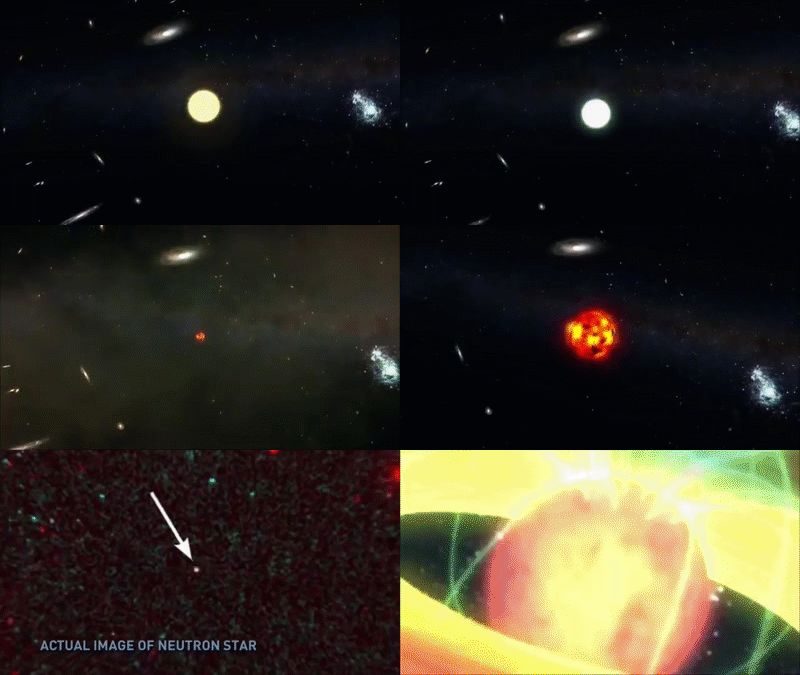
There are so many types of neutron stars. The two commonly known types are Pulsars and Magnetars. These are the two most remarkable neutron stars. Since Neutron stars do not emit radiation, they are most likely undetectable. The neutron stars can be observed at the center of Supernova remnants emitting X-rays. The internal structure of the neutron star is still unclear and much of a debate. Currently, researches say that the star possesses a thin crust of iron for a mile distance. Under this layer, it is mostly composed of neutrons and further down, it takes various unknown forms.
If you think, when does a neutron star die? Well, once the neutron star has formed, it does not generate any light or heat on its own. Gradually within millions of years, its latent heat will cool down from 600,000 degrees kelvin.
Once a glorious star will eventually become a cold, dead remnant star.
Now that the neutron star is dead, what could happen when these two dead stars meet each other? It not only has created a remarkable event out there in space. But, it also was a remarkable event on Earth too. Click here to know about it.
 StarDustWaves
4 thoughts on “Neutron Star 5.0”