Our solar system, approximately 4.6 billion years ago, was just a cloud of dust and gas known as a solar nebula. At some point the cloud would collapse itself, maybe due to the supernova explosion that happened nearby that caused it to compress forming a flat spinning disk of dust and gas. Now, the gravity collapses the material. As it begins to spin, it causes the nuclear fusion thus forming the sun at the center of the nebula.

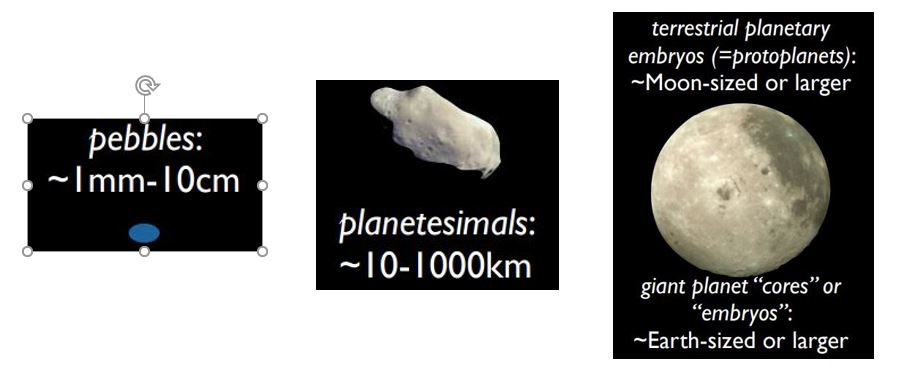
The significant stuffs that are needed to form a planet are pebbles, planetesimals and the embryo. The pebbles are like the rocks that are on the beach. Planetesimals are like 100km in size and planetary embryos are like the core or moon or like a mini-planet. Basically speaking, a planet forms by collecting a bunch of rocks/planetesimals. But, it has to go through a lot of phases, consequences and more dramatic situations. And gradually it forms a planet.
There are the different stages of Planet formation. Starting from dust grains within the gas dominated by young stars, stick around forming the pebbles. Pebbles clump together and form planetesimals. These planetesimals bash into each other and grow into embryos or cores. While there is gas in the disk, those cores can also change their orbits due to orbital migrations. These objects embedded within the disk tend to create spiral density waves and can migrate around, causing Type 1 migration. While there is gas, these cores can join together to form Jovian planets like Jupiter. These can also migrate and they tend to have a different type of migration usually called as Type 2 migration. Here the density waves can be seen. But instead of being embedded within the disk, it creates a sort of angular gap between the disk. Once the gas is gone, after a few million years, the giant planets can go unstable. In this case, due to its interaction with other planets, they tend to move away from its orbit. Once the gas is completely gone, there will be a final phase of giant impacts. Thus finally, rocky planets will be formed.
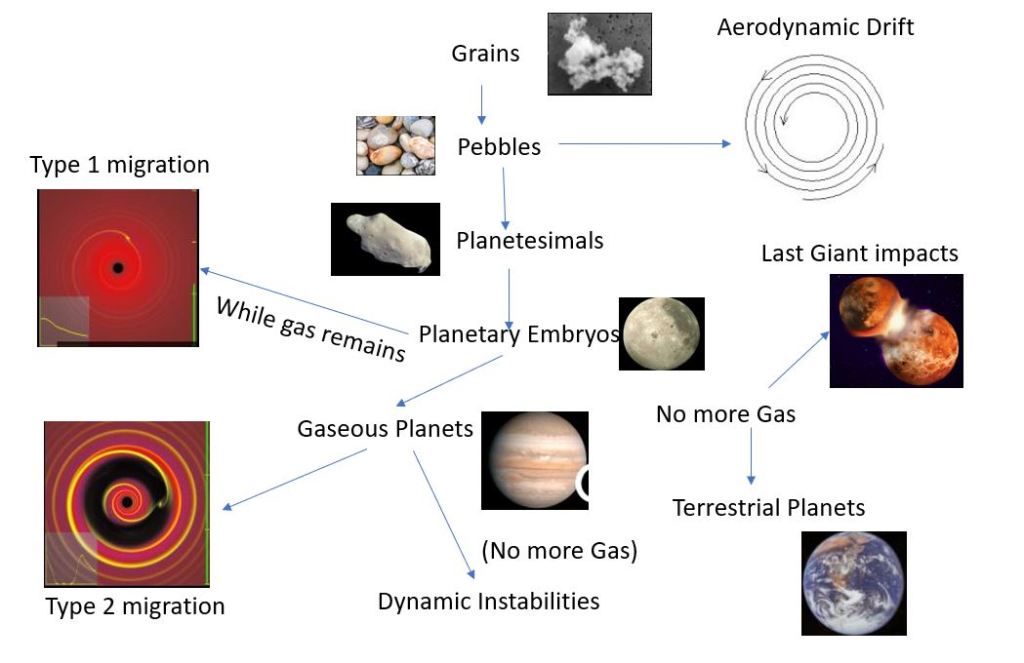
Planetesimals are the key for planet forming in the disk. The reason is that the speed at which the gas orbits falls in a gravitational path but has an extra pressure support because gas closer to the star is hotter; so it pushes outward. Therefore, the pebbles that are moving in this path feel a headwind because it is closer. Pebbles usually don’t stick around, they drift within the disk. They drift spirally inward. And there is a pile of gas and slows it down, losing its orbital energy causes it to spiral inward. This is the reason for this drift. And the typical timescale for this drift would be thousands of years. This is faster than the lifetime of a planet forming disk which is over millions of years.
How the Planetesimals are formed? It is mostly due to streaming instabilities. The particles that are orbiting the star, it feels the drag force. When enough particles come closer together, there will be concentration of the particles in that area. This can speed up the gas a little bit and it changes its dynamics and if any other particle comes closer, it forms an even more higher concentration. That’s how planetesimals are formed. But the actual question is When and where these planetesimals first formed in the disk? There are many papers that are evident of planetesimals forming in different regions like in the ring or in the broadened region of the disk. But the research is still going on to find when and where these planetesimals are FIRST formed.
Pebble accretion: When pebbles and planetesimals are being together at the same time , this results in obtaining even larger objects. This situation leads to pebble accretion, It is a very efficient one. The gravitational interaction with the gas helps the pebble to spiral. This is one of the key processes for the core of the giant planet to form. Usually, planetesimals take a lot more time than the pebble to interact with the other particles. Also, the gas remains in the disk only for a few million years. So, in order to form the Jovian planet, the process has to be hurried up. That’s the reason why pebble accretion is more effective than planetesimal accretion.
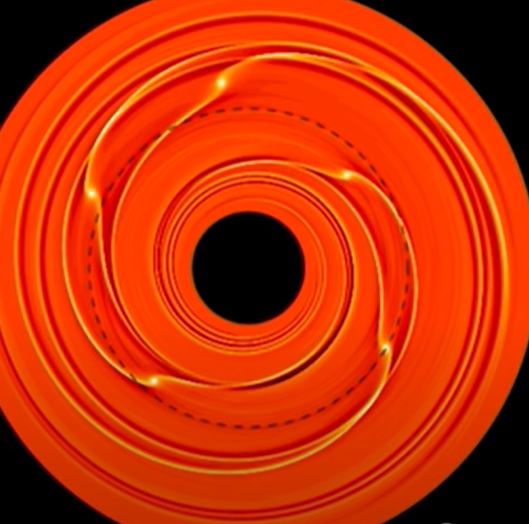
Migration: When a growing core interacts with the disk, the spiral wave becomes denser and as the core gets massive, there will be a gap formed between the core and the gas. This is due to the gravitational interaction between the planet and the disk leading to orbital migration. Type 1 migration is often called as low mass regime. In this type, the planet will be still embedded within the disc. So, they tend to produce density waves in the disk. In the below image, you can spot 5 planets, a denser thick spot which are 3 times more massive than Earth. These are embedded in the disk. Each one of them is launching the spiral wave onto the disk. This produces torque on their orbit. It either enlarges their orbit or shortens the planet’s orbit. Migration does happen even for the less mass stars but at a slower rate.
Core accretion: A large core, almost 5 – 10 Earth-masses grows and grabs onto some gas. That’s how the gas planets form in simple words. How does it happen? In the early phase, the core grows rapidly and then there will be a longer phase where it gathers gas. This gas has to cool down so that it gets compressed and again more gas will be piled up and the process gets repeated until a critical point is reached. As it forms, they tend to have other modes of migration i.e. type 2. Here the planet will not be embedded within the disk. The migration with the high mass planets is a lot slower than the low mass. Here, the migration will be mostly inward. There are some cases which can be outward. But in the case of the solar system it is mostly inward.
After the gas is gone, the planetesimals and embryos form into terrestrial planets. It is characterized by big impacts between objects. One of the best examples could be Moon Impact. Thus forming the whole solar system. And a solar system is not only the planets it has other left-over stellar objects like asteroids, meteoroids, comets.

A recent discovery of a moon forming event was detected using ALMA observatory. For the first time, researchers have spotted a moon forming a disk around a planet called PDS 70c which revolves around a very young T Tauri star (PDS 70) in the constellation Centaurus. It is located approximately 400 light-years away from Earth.
PDS 70 has a mass of 0.76 Solar Masses which is approximately 5.4 million years old. It is revolved by two planets PDS 70b and PDS 70c. Both the planets are similar to our gas-giant planet, Jupiter. This event is happening around PDS 70c and it orbits the star at 33 times the distance of the Earth from the Sun.
Our moon has been formed by a giant impact by a Mars sized planet. But in that it is being formed from a circumplanetary disc. No circumplanetary discs had been found until now because all the extra solar systems we have ever observed are fully developed solar systems. But the planets in this solar system are still young. They are at their dynamic stage at which acquiring the atmospheres in them is still in process.
As we move further, the orange dwarf star at the centre of the system comes into view, as does PDS 70b, another planet found in this system. We also see a large ring, a remnant of the circumstellar disc from which the two planets have formed.
At the end of the video, we see the real astronomical image of the system, taken with the Atacama Large Millimeter/submillimeter Array (ALMA).
Credit:ESO/L. Calçada, ALMA (ESO/NAOJ/NRAO)/Benisty et al.
The circumplanetary disc around PSD 70c has the diameter equal to the distance of the Earth to the Sun. There is a possibility that it could form more than one moon. Let’s be amazed until then!
 StarDustWaves