
It’s often said that humans are like clouds, here one moment, gone the next. But have you ever thought that the breathtaking, colossal rings of Saturn—something you’ve admired since you were young—could also disappear into the cosmos, just as fleeting as those passing clouds?
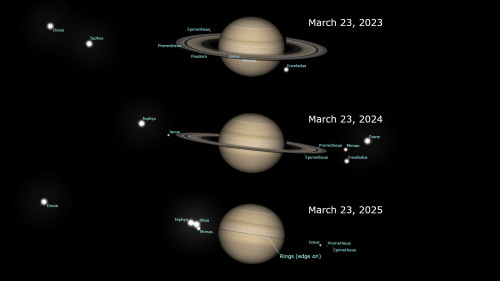
Saturn’s iconic rings, slowly fading over the course of 100 million years, will give us a rare preview of their vanishing act —mark your calendars for March 23rd, 2025, when you’ll witness this cosmic ballet.
It’s a melancholic truth—Saturn’s majestic rings are slowly fading, and in 100 million years, they’ll be gone forever. But have you ever wondered what is truly going on within Saturn’s dazzling halo? Allow me to unfold the story behind its slow, inevitable disappearance.
In the quiet dance of the cosmos, Saturn’s rings are performing their final act. The culprit behind this celestial vanishing is a mysterious phenomenon known as “ring rain.” Imagine Saturn’s gravity, constantly tugging at the icy and rocky chunks that form its stunning rings. But gravity alone isn’t responsible—there’s a hidden partnership with sunlight and magnetic fields. As the sun’s rays hit the particles, they become charged, and like enchanted dust, they begin to follow Saturn’s magnetic field lines, spiraling down toward the planet. Slowly but surely, this rain is erasing the rings.
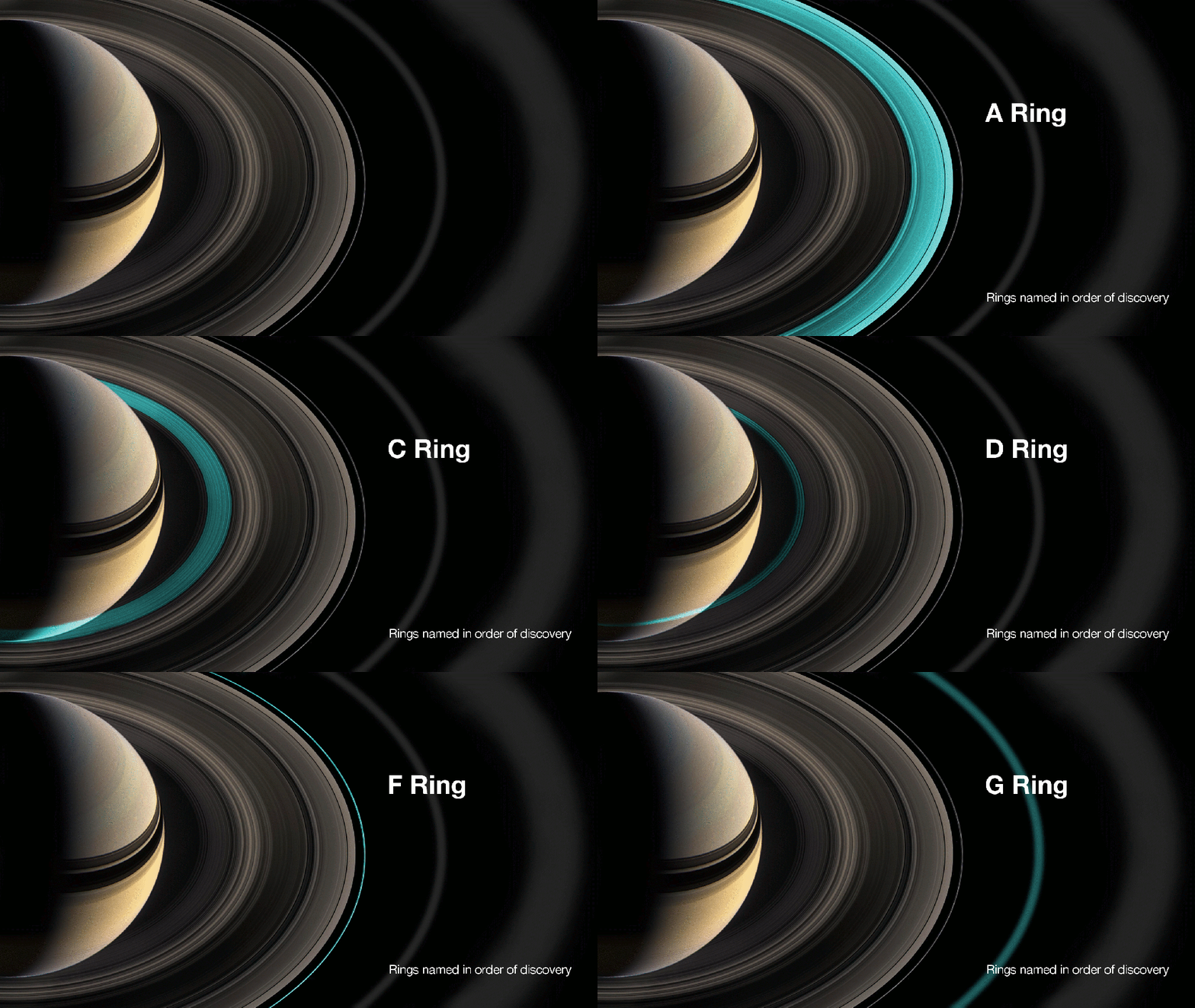
While you read this article, Saturn is being showered with 432 – 2870 kilograms of its own majestic rings every second—a celestial drizzle known as “ring rain.” We first became aware of this cosmic phenomenon in the 1980s when NASA’s Voyager mission spotted mysterious dark bands, later revealed to be ring particles caught in Saturn’s magnetic fields. At that time, scientists estimated the rings would fade away in 300 million years. But when NASA’s Cassini spacecraft took a final, closer look during its breathtaking plunge into Saturn’s atmosphere in 2017, it uncovered a more somber reality. The rain was heavier than we had ever imagined, and now, Saturn’s stunning rings are predicted to vanish in just 100 million years.
While Saturn itself formed approximately 4.5 billion years ago, research indicates that its rings are relatively young, dating back only 100 to 200 million years. This means Saturn’s rings are younger than several species of dinosaurs that once roamed the Earth. We are fortunate to be observing Saturn during this unique period, as the rings are predicted to disappear sooner than expected before.
Next year, in early 2025, you’ll have the rare opportunity to observe Saturn without its rings. Yes, you read that correctly—Saturn’s rings will temporarily disappear. You might be curious about how this phenomenon occurs, and the explanation lies in the precise alignment of planetary orbits.
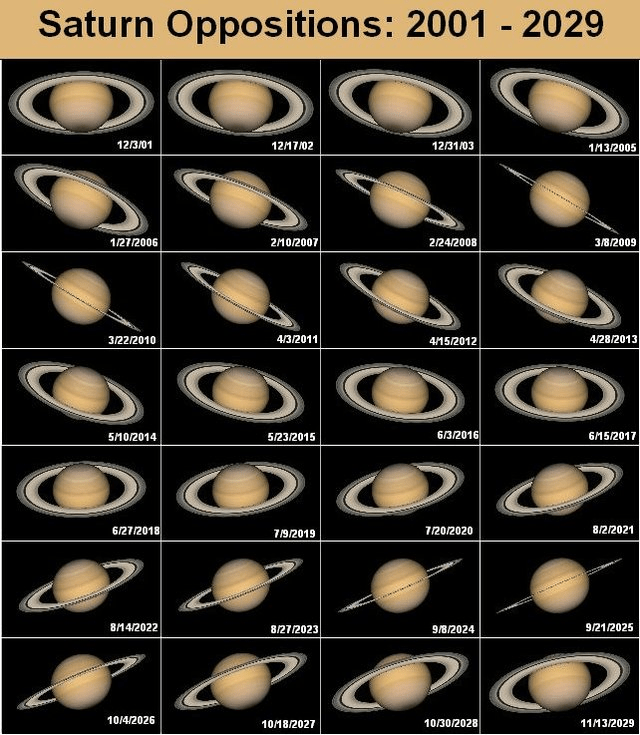
Saturn’s rings are so thin that they almost disappear when viewed from the side. As Earth and Saturn orbit the sun, every 13 to 16 years we reach the perfect angle to see this. Saturn’s 29.4-year orbit tilts it at 26.7 degrees, so sometimes we see the upper side of its rings, and other times, the lower. But when Earth moves through Saturn’s “ring plane”—the space aligned with the edge of its rings—we get the rare sight of Saturn appearing ringless.
Every 13 to 16 years, Earth sees Saturn’s rings edge-on, meaning “they reflect very little light, and are very difficult to see, making them essentially invisible” Peroomian said. The rings last went edge-on in 2009 and they will be precisely edge-on on March 23, 2025, he said.
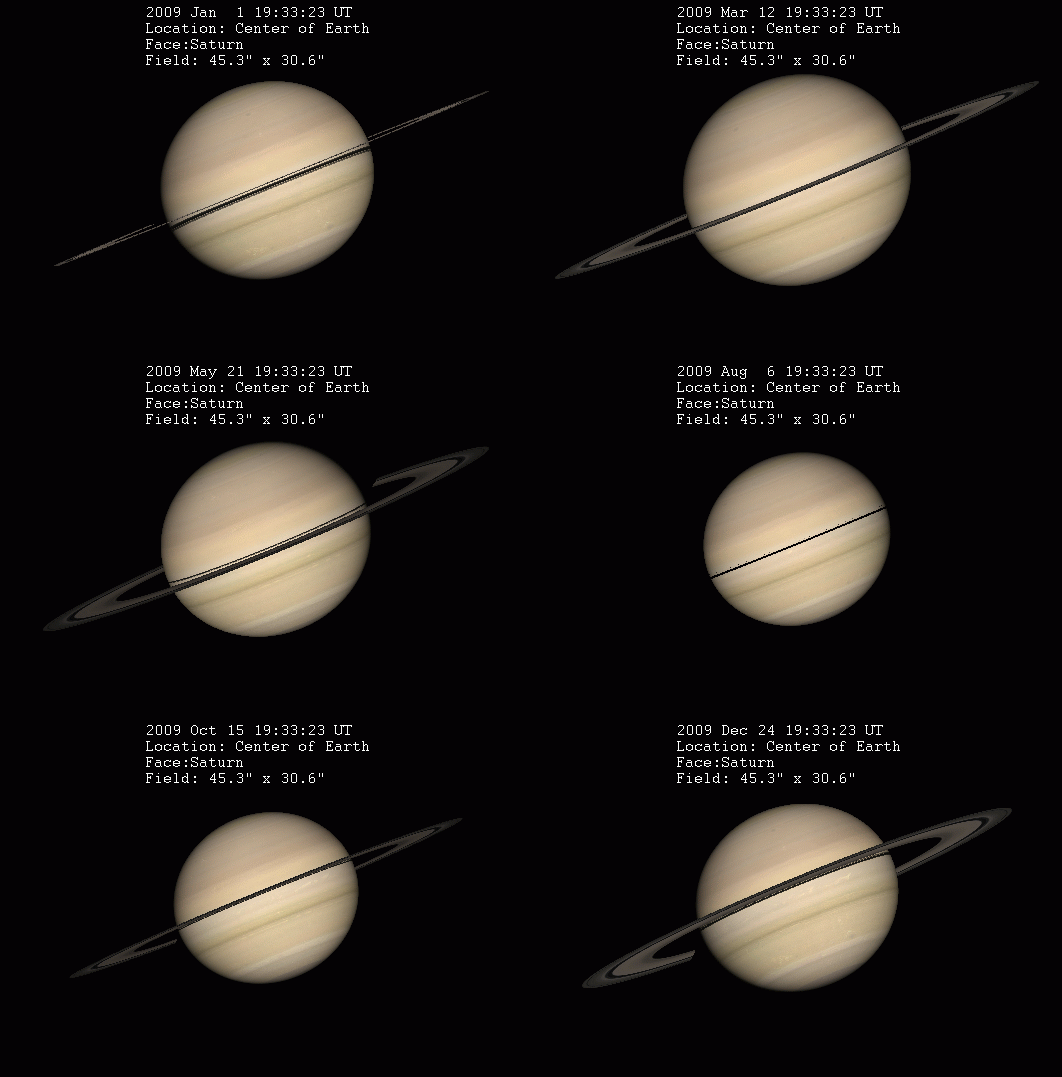
We’ve had the privilege of witnessing this rare cosmic event before, in 1995 and 2009, and now it’s set to happen once again next year! But how long will Saturn’s rings remain hidden from view? Fear not, for they will gradually reappearing over the span of a few months.
Be sure to grab your telescopes or binoculars and head outside —whether it’s your backyard or a nearby dark location—or visit your local astronomical observatories to witness this extraordinary astronomical event. It’s an opportunity you won’t want to miss!
If the thought of Saturn’s rings vanishing one day troubles you, take a moment and look at it as you would with loved ones—their memory lingers, shining as brightly in our hearts as Saturn’s rings do in the cosmos. Embrace the beauty while it lasts and while you are alive!
References:
- https://www.smithsonianmag.com/smart-news/saturns-rings-will-disappear-from-view-in-2025-but-its-only-temporary-180983244/
- https://www.cbsnews.com/news/saturns-rings-disappear-from-view-march-23-2025-nasa-expert-says/
- https://www.chron.com/news/space/article/saturn-rings-disappear-18493203.php
- https://www.theweathernetwork.com/en/news/science/space/saturns-rings-will-disappear-in-2025-due-to-ring-crossing-event
 StarDustWaves