
Black hole is a place in space where gravity pulls so much that even electromagnetic radiation-LIGHT cannot escape. The gravity is so strong because matter has been squeezed into tiny space.
Black holes are some of the strangest and the most fascinating objects found in outer space. These are the objects with greater density, with strong gravitational attraction. Black holes in space can be identified by the X-rays emitted from it.
THE 1ST PREDICTION :
Albert Einstein first predicted black holes in 1916 with his general theory of relativity. The term black hole was coined in 1967 by American astronomer John Wheeler and the first one was discovered in 1971.
HOW THE BLACK HOLES ARE FORMED:
Stars are sustained by nuclear fusion reactions taking place in their cores. The energy that is produced in these reactions is enough to support their mass against its own gravity. As a star runs out of fuel it can expand and will begin to form heavier elements such as carbon and iron. Once it finally exhausts all its fuel it will begin to collapse. Thus the death of the star results in the Supernovae explosion and this may end up with the formation of the black hole. Scientists think the smallest black holes formed when the universe began.
TYPES OF BLACK HOLES:
There are three types of black holes . They are Stellar black holes, Super massive black holes and Intermediate black holes.
STELLAR BLACK HOLES:

When a star burns through the last of its fuel, it may find itself collapsing. For smaller stars, up to about three times the sun’s mass, the new core will be a neutron star or a white dwarf. But when a larger star collapses, it continues to fall in on itself to create a stellar black hole.
Black holes formed by the collapse of individual stars are (relatively) small, but incredibly dense. Such an object packs three times or more the mass of the sun into a city-size range. This leads to a crazy amount of gravitational force pulling on objects around it. Black holes consume the dust and gas from the galaxy around them, growing in size.
According to the Harvard-Smithsonian Center for Astrophysics, “the Milky Way contains a few hundred million” stellar black holes.
SUPERMASSIVE BLACK HOLES
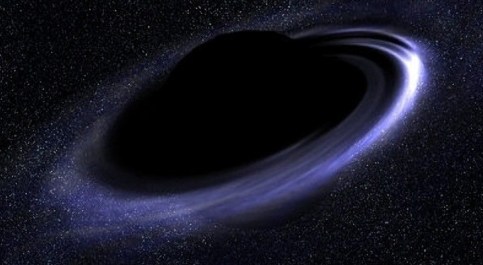
Small black holes populate the universe, but their cousins, super massive black holes, dominate. Super massive black holes are millions or even billions of times as massive as the sun, but have a radius similar to that of Earth’s closest star. Such black holes are thought to lie at the centre of pretty much every galaxy, including the Milky Way.
Once they’ve formed, they can easily gather mass from the dust and gas around them, material that is plentiful in the centre of galaxies, allowing them to grow to enormous sizes. Super massive black holes may be the result of hundreds or thousands of tiny black holes that merge together.
INTERMEDIATE BLACK HOLE:
Scientists once thought black holes came in only small and large sizes, but recent research has revealed the possibility for the existence of midsize, or intermediate, black holes (IMBHs). Such bodies could form when stars in a cluster collide in a chain reaction. Several of these forming in the same region could eventually fall together in the centre of a galaxy and create a super massive black hole.
HOW CAN WE SEE BLACK HOLE:
Because a black hole is indeed “black” — no light can escape from it — it’s impossible for us to sense the hole directly through our instruments, no matter what kind of electromagnetic radiation you use (light, X-rays, whatever.) But the environmental condition surrounding black hole acts enormously differently. For example : say a star happens to get too close to the black hole . The black hole naturally pulls on the star and rips it to shreds. When the matter from the star begins to bleed toward the black hole, it gets faster, gets hotter and glows brightly in X-rays. Thus we can locate the black hole in space.
DOES OUR GALAXY HAS A BLACK HOLE:
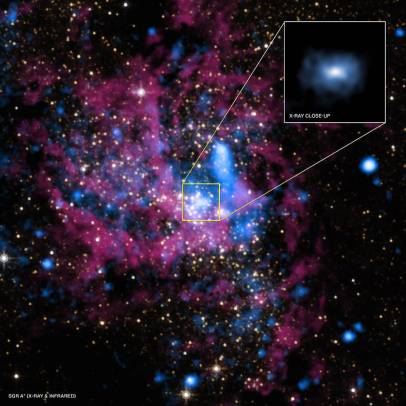
In the middle of our Milky way galaxy there is a huge super massive black hole present. Luckily we are nowhere near this black hole-we are about two-thirds away from the centre , relative to the rest of our galaxy — but we can certainly observe its effects from a very greater distance. The Super massive black hole at the centre of the Milky Way galaxy is called Sagittarius A. It has a mass equal to about 4 million suns and would fit inside a very large ball that could hold a few million Earths. In the above image the white light indicates the X-ray emitted from the black hole which is present in our galaxy.
WE AREN’T SURE WHETHER WORM HOLES EXISTS OR NOT..
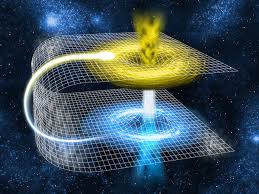
A wormhole is a passage through space-time that could create shortcuts for a long journey in the universe. Wormholes are predicted by the theory of general relativity. Wormholes are just theoretical predictions by the scientist . Some people believe these objects are a sort of wormhole to other parts of the Universe, making faster-than-light travel possible. But Scientist doesn’t have any proof for the existence of a wormhole.
CAN BLACK HOLE SUCK ITSELF IN?
A black hole can’t suck itself in, but it can suck in other black holes (as well as sucking in gas, dust and stars). When a black hole swallows another black hole (or anything else) it grows larger, and this is one of the ways to grow supermassive black holes that are millions of times more massive than our sun, and often found in the centre’s of galaxies.
ON THE OTHER SIDE OF BLACK HOLE..:

If you fall into a black hole you are guaranteed to hit the centre, which is called the singularity. At the singularity you would be crushed into a ball of almost infinite density, which would destroy anything, even atoms, protons, or quarks. Some people have considered the idea of a “wormhole”, where you would never get to that density, but to make a long story short it appears that such things probably can’t exist in reality. In short there is no other side of black hole.
LIGHT IS THE FASTEST SPEED KNOWN-THEN HOW IS IT BLACK HOLE CAPTURES LIGHT:
Even though the speed of light is faster than anything else in the universe, it still cannot escape the gravitational pull of the black hole!
Einstein tells us that really heavy objects, such as a black hole, warps the space around it, causing it to “sink down,” in a manner of speaking. Think of it like this: space is a nice, flat blanket that you’re holding up in the air on its four ends. When you put heavy stuff on the blanket, such as a brick, the blanket bends downwards, and that’s what heavy stuff does to space. When light, which is made out of little packets of energy called photons, passes near these sinkholes, they try to go around it in a curve and sometimes get “sucked in” to where the mass is. Because these sinkholes made by black holes are really, really steep, even light, moving really, really fast, cannot escape it!
WHAT HAPPENS IF WE FELL INTO THE BLACK HOLE?

One of the theories says, if we fell into the black hole , due to the strong gravitational force of the singularity , our body would be stretched until our body’s out of its matter and we would be dead before we reach the singularity itself. And what happens to Einstein’s theory of relativity? This is explained by one person (call them Unlucky) falling into a black hole while another person (call them Lucky) watches. From Lucky’s perspective, Unlucky’s time clock appears to be ticking slower and slower. This is in accordance with Einstein’s theory of general relativity, which (simply put) says that time is affected by how fast you go, when you’re at extreme speeds close to light. The black hole warps time and space so much that Unlucky’s time appears to be running slower. From Unlucky’s perspective, however, their clock is running normally and Lucky’s is running fast.
The other theory says that if we fell into the black hole , we may be able to reach another universe (i.e.) Some scientists believe that black holes can lead us to different dimensions or other galaxies like a short cut. But still Physicists got no proof for both theories.
NASA’S STUDIES ON BLACK HOLE:
NASA is using satellites and telescopes that are travelling in space to learn more about black holes.


A black hole is a place where the matter once again transformed into a substance ether, from which he was begin using high vibrations of ether. Then form kvark- gluon stars, which formed in particular by a neutron star, but a supernova, an exploding from her heavenly bodies are formed, depending on the type of transformation and conditions that are predetermined. Then arises, among other properties of matter and gravity, which has the task to a specific substance back into the ether through a black hole. Thus forming a closed circle appearance and disappearance of matter and black holes is a place of transition and borders matter in the form of ether. Where there is no matter, there is no time nor space, because there everything happens instantaneously.
LikeLike