
Yes, the same word ‘Boomerang’ you see in Instagram and Facebook. But no, it does not keep on repeating what it is doing now! Boomerang indicates its symmetric structure as seen from ground-based telescopes. This nebula is also known as Bow Tie Nebula. There are approximately 45 known nebulae in our galaxy and including our neighboring galaxies. But this one nebula amaze me for a particular fact which is “This nebula is the coldest object in the known Universe!“. It’s temperature is measured to be at 1 Kelvin (i.e. -272.15 degree Celsius).
This Boomerang nebula is a proto-planetary nebula that was created by a dying red giant star located about 5000 light years from Earth in the direction of Southern constellation Centaurus and it has been a mystery for astronomers since 1995.
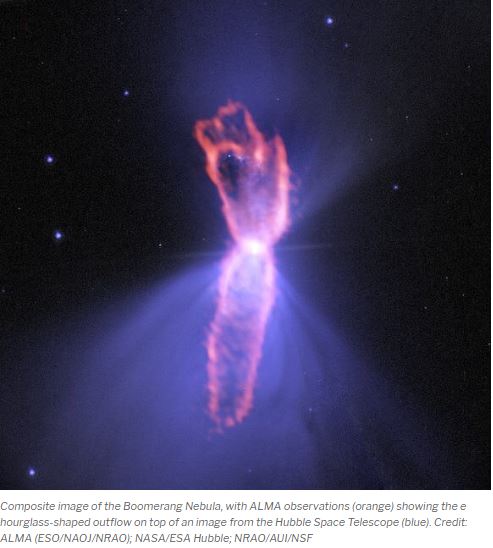
Using a 15-meter Swedish-ESO Submillimeter Telescope(SESTI) in Chile, astronomers found that this nebula is the coldest object. And now over 25 years later, we might have found a reliable answer. Another team of astronomers who used the Atacama Large Millimeter/submillimeter Array (ALMA) located in Chile, said that the cool temperature may be because of a small companion star plunging into a red giant. So, during this process, an ultra-cold outflow of gas and dust could have been created while it ejected most of the larger star’s matter resulting in colder temperature. This team also published a paper in Astrophysical Journal titled “The coldest place in the universe: Probing the Ultra-cold Outflow and Dusty Disk in the Boomerang Nebula”. Several arguments popped up regarding this paper.
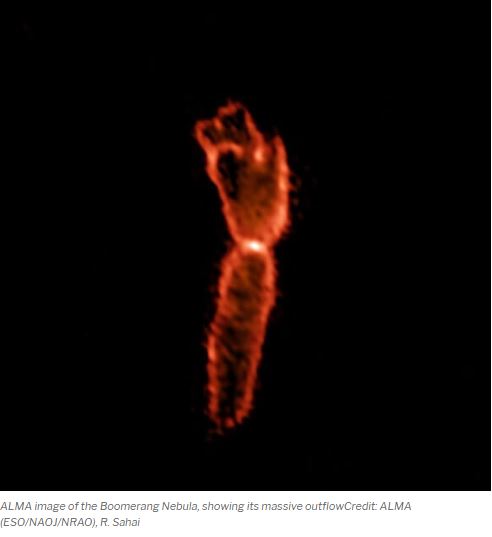
This nebula is only 1 degree Celsius warmer than absolute zero. Also, the temperature during the big bang glow was calculated to be -270 degree Celsius which was warmer than the nebula. Finding these mysteries will let us know more about how giant stars and their companions behave and their interactions with the binary system say a star consumes a smaller companion star and may become a cosmic freezer like such a similar condition.
In 2013, observations of ALMA radio interferometer revealed that the nebula’s outer fringes appear to be gradually warming. But not as warm as the other nebulae. Well, the mystery still continues!!
 StarDustWaves
😊😊😊😊
LikeLike