
Do you know what is the most devastating thing? A Breakup. But astronomers find it more interesting when a comet is breaking up as it passes through our inner solar system. How amazing astronomers can be!
Comets are considered as ‘minor bodies‘ in our solar system. They are irregularly shaped bodies which mostly consist of water ice, dust, carbon and silicon-based compounds. Comets are like wanderers in our solar system which has a constant elliptical orbit. Comets have three distinct parts: a nucleus, a coma and a tail. The solid core is called the nucleus. The coma is the dusty, fuzzy cloud around the nucleus in the comet and the tail extends from the comet and points away from the sun. Also, our Earth and Comets might have a connection billions of years ago. During the dry newborn Earth era, a comet shower might have resulted in contributing some water in the oceans. They may have seeded Earth with organic compounds, the precursors to life as we know it. Some of the well-known comets are Comet Halley and Comet Hale-Bopp.
So, the comet named C/2019 Y4 (ATLAS – Asteroid Terrestrial-impact Last Alert System) was discovered in December 29, 2019. The comet was captured by Hubble’s Space Telescope which was operated by two teams. One of which is UCLA, California and the other is University of Maryland, Maryland.
These teams were able to provide the sharpest views yet of the fragile comet breakup. They identified about 30 fragments on April 20, 2020 and 25 fragments on April 23, 2020. Astronomers aren’t really sure about the cause of fragmentation. However, Hubble distinguishes each piece as small as the size of a house. And before the fragmentation occurred, the entire nucleus might be approximately the length of two football fields! Astronomers believed that this comet could be the brightest to sweep past Earth when they first discovered it. But, after the fragmentation, the comet started to get dimmer instead of brighter.
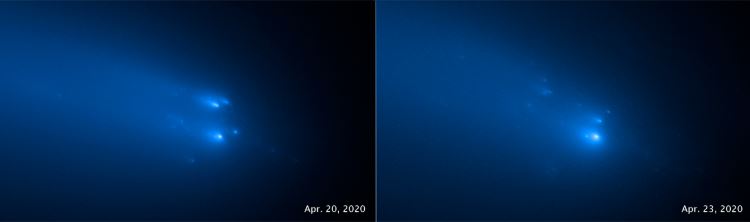
Image credit : NASA, ESA, D. Jewitt (UCLA), and Q. Ye (University of Maryland)
The disintegrating comet was approximately 146 million kilometers away from Earth when the latest observations were taken. If any of the nucleus in the comet survives, ATLAS will make its closest approach to Earth at a distance of 116 million kilometers on May 23′ 2020.
This event may result in understanding more about comets and get to know some of its mysteries. Like why the comet’s nucleus disintegrates? Is it due to the influence of the Sun when the comet enters the inner solar system? Or could the icy nucleus spin up as it shoots out jets of warming gasses? Hope this could be the one to solve these mysteries!
 StarDustWaves
Break-up = freedom
LikeLiked by 2 people
Haha, Ironically speaking…
LikeLiked by 1 person
After the disappointment of Hailey’s, I was hoping for another bright one like Hale Bopp. Oh well, I guess I will have to wait for the next visitor. Thanks for the post.
LikeLiked by 2 people
Unfortunately, we need to wait for another 60 years or so for the comets visiting us.
LikeLiked by 2 people