
We are not alone in this observable universe. I didn’t mean the aliens though. I meant that the planets in our solar systems aren’t the only ones seen in this universe. There are thousands of planets that have been discovered since 1991 just like our solar system. These newly discovered planets which are many light years away from us are known as Exoplanets. Like in our solar system, a star rotated by 8 planets, it doesn’t have to be in the same numbers when it comes to other exoplanets. It can be a star rotated by 2 or 3 planets or it can be just 1 planet orbiting 3 stars. Such a system is known as a three star system. Fascinating, ain’t it? Click here to find some more interesting information about exoplanets.
Till date, astronomers have discovered 4152 confirmed exoplanets. Basically Exoplanets can be identified using four methods. Transit method, Radial velocity method, Microlensing and Imaging method.
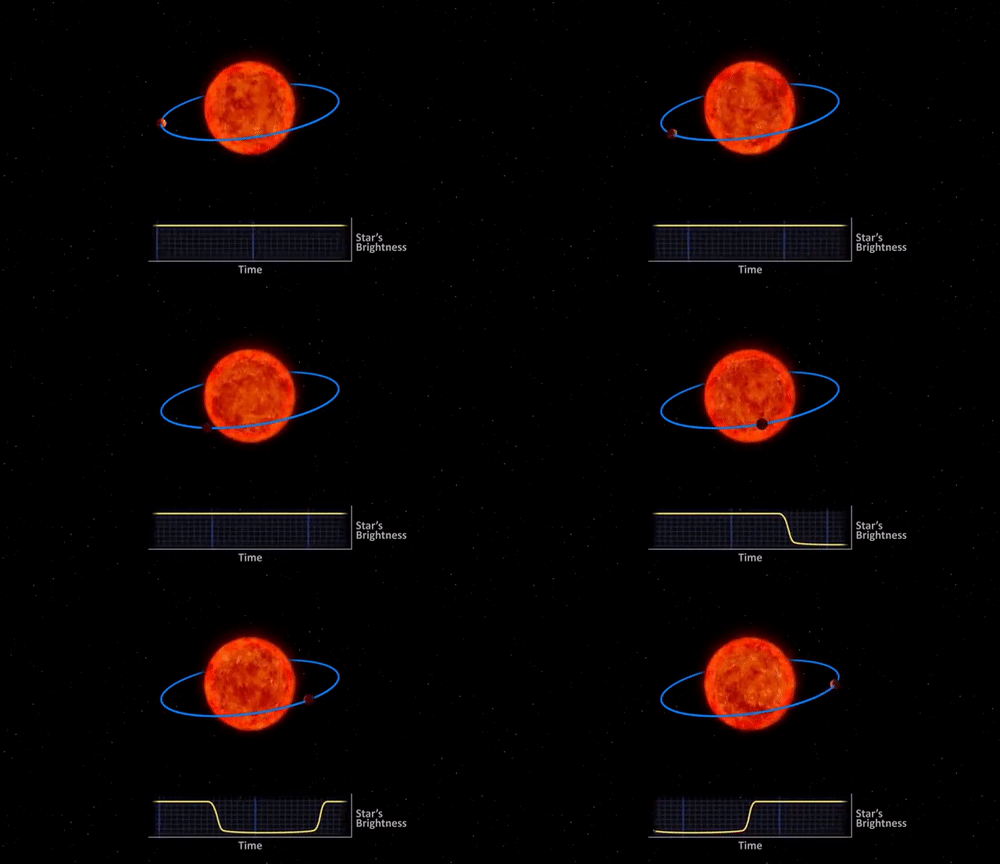
Transit method : When a planet passes directly between its star and an observer, it dims the star’s light by a measurable amount. This is the very common method for hunting exoplanets. According to NASA, 76.1% of exoplanets are identified using this method.
Radial velocity method : While planets orbit their stars, it causes the stars to wobble in space which causes an observable shift in the color of the star’s light. According to NASA, 19.3% of exoplanets are identified using this method.
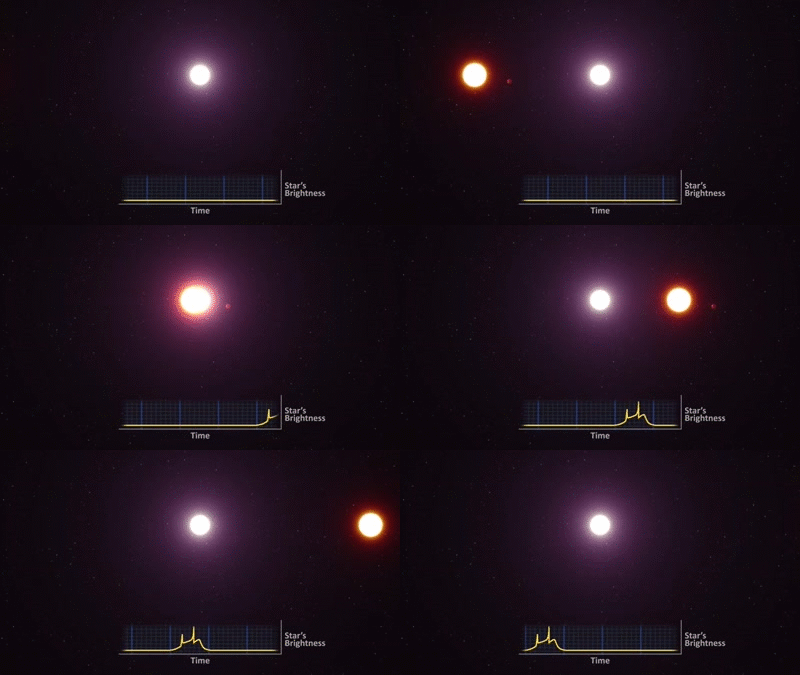
Microlensing : Every stellar object emits light. Likewise, When a star passes in front of another star, it bends the distant starlight like a lens, making it brighter. If the lensing star has an exoplanet, it acts like another lens, making the star even brighter. According to NASA, 2.1% of exoplanets have been discovered by this method.
Imaging method : Imaging is one of the methods by which astronomers can take pictures of exoplanets using a technique that removes the overwhelming glare of the stars they orbit. According to NASA, only 1.2% of the exoplanets were discovered using this method.
Among 4152 exoplanets, each planet is separated under ideal categories. Speaking of various categories, each star system has different kinds of planets. The categories are Neptune-like or Jupiter-like planets, Gas giant planets, Super Earth Planets, Terrestrial planets, Unknown category.
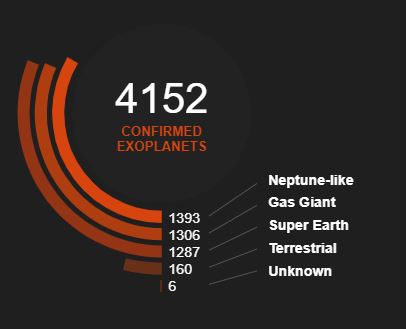
As you can see, there are like 1287 Super Earth exoplanets in our observable universe. These planets are in a habitable zone, hence they come under the category of Super Earth. And among these planets, taking sustainable environments into account, human life could be possible!
Here is a short video of nearly 4000 exoplanets discovered till the year 2019.
Out of all these planets, in the whole observable universe, there might be alien life present somewhere in these exoplanets. And since we have official UFO confirmation recorded in 2004 and 2015, it’s just a matter of time to contact aliens out there! Until then, be excited…
 StarDustWaves
So, if there are thousands of Super Earth, does that mean we can live there?
LikeLiked by 1 person
Well, it depends on so many factors. Like, whether does that planet has sustainable environment like we do at Earth and most of all time factor to reach that exoplanet matters! Like for example the recently discovered exoplanet ‘Kepler-1649 c’ is 300 light years away from us. That would approximately take thousands of years!
LikeLiked by 1 person
What about the nearest exoplanet?
LikeLiked by 1 person
It seems that the nearest exoplanet is Proxima Centuari b which itself is 4 light years away and again takes thousands of years! and 300 light year takes no less than million of years !
LikeLiked by 2 people
That’s true indeed… And our observable universe is BIG
LikeLiked by 1 person