Brown Dwarf Stars are somewhat special compared to all the other dwarf stars. Stars are categorized by their spectral class. Brown dwarfs designated as types M, L, T and Y.
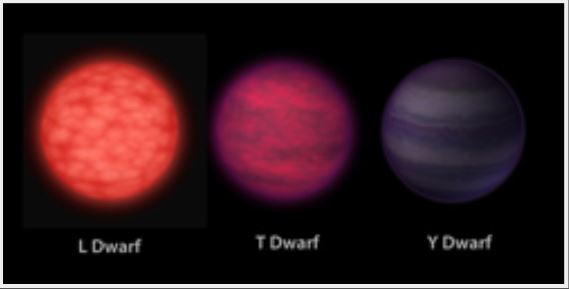
Class M brown dwarf stars are the hottest and have temperature above 1300K and therefore are the youngest of all brown dwarfs. They are visible as Magenta to our naked eyes.
Class L brown dwarf stars are cooler than M type brown dwarfs and have their temperature in the range 1300 K to 2000 K. They appear as red-brown color. These stars are identified by metal hydride emission bands such as FeH, CrH, MgH, CaH and they have prominent alkali metal lines such as Na I, K I. Example of class L brown dwarf star is GD 165B.
Class T brown dwarf stars are even cooler than class L and their surface temperature range 700 K to 1300 K. They appear as dark magenta color due to the abundance presence of Methane in their spectra. They have broad absorption features from the alkali metals such as Na and K. Example for such brown dwarf is Gliese 229B which is 19 light years away from Earth.
Class Y brown dwarfs are Ultra-cool with their surface temperature less than 600 K. They do not have any methane content in their spectral lines. They are very dim brown in color. Until early 2011, there were no identified brown dwarf stars in this type. The first class Y brown dwarf was identified later that same year and named unusually as UGPS J072227.51-054031.2 which is just 13 light years away from us.
As I mentioned earlier, brown dwarfs are indeed special. In fact, they gave us a fantastic riddle that resulted in enhancing a separate research area about brown dwarf stars. The riddle goes like this “I’m bigger than a planet, but I’m not a star. And I’m smaller than a star, but I’m not a planet. Who am I?“
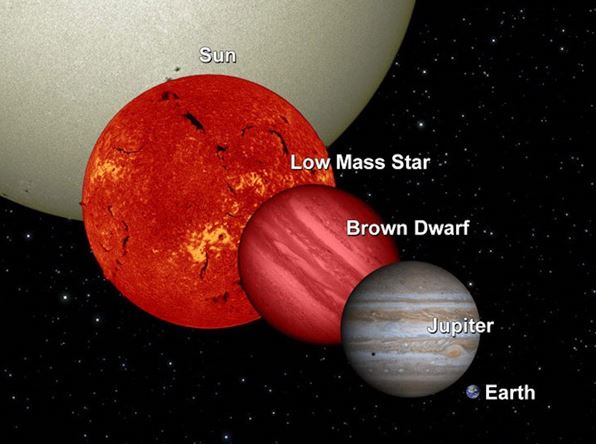
Yes, brown dwarf stars are exotic stellar objects of our universe. These stars with their masses ranging from 12 times that of Jupiter up to half the mass of the sun. So, we might classify brown dwarfs stars as the odd variety of very large planets. But, when it comes to the major classification between a star and a planet, Brown dwarfs stars emit light on their own and the planets have no new sources of energy to keep their fires lit, they just become a rocky planet where no fusion can take place.
Sun-like stars have a core of hydrogen and helium surrounded by a layer of plasma dominated by radiating energies. But given the range of masses like brown dwarf stars, there is no core per se. The stellar object would not have been able to sustain the fusion of hydrogen into helium like a regular star. Thus, astronomers consider brown dwarf stars as “failed stars” that’s left with the exotic quantum force known as degeneracy pressure. These stellar objects simultaneously act like both planets and stars and act like neither of those.
We know that stars don’t shine forever. But what about these brown dwarf stars? Brown dwarfs cannot die. Speaking of failed stars, these stars are considered to be already dead. For such very low mass stars that never become Main Sequence stars, they radiate heat and contract. They simply cool off and fade out of view and remain a dull brown dwarf.


3 thoughts on “Brown Dwarf Stars 1.04”