
We have reached the last segment of the star series. Studying about stars is an interesting pastime, don’t you think? Better understanding can deepen your appreciation of Astronomy and also your love for Stargazing would increase 🙂
Including Supergiant stars, there are totally 5 types of Giant stars existing in this universe. They are Subgiants, Giants, Bright Giants, Supergiants, Hypergiants. This is arranged according to their luminosity classes of the star type. Click here to know about Star Classification in detail.
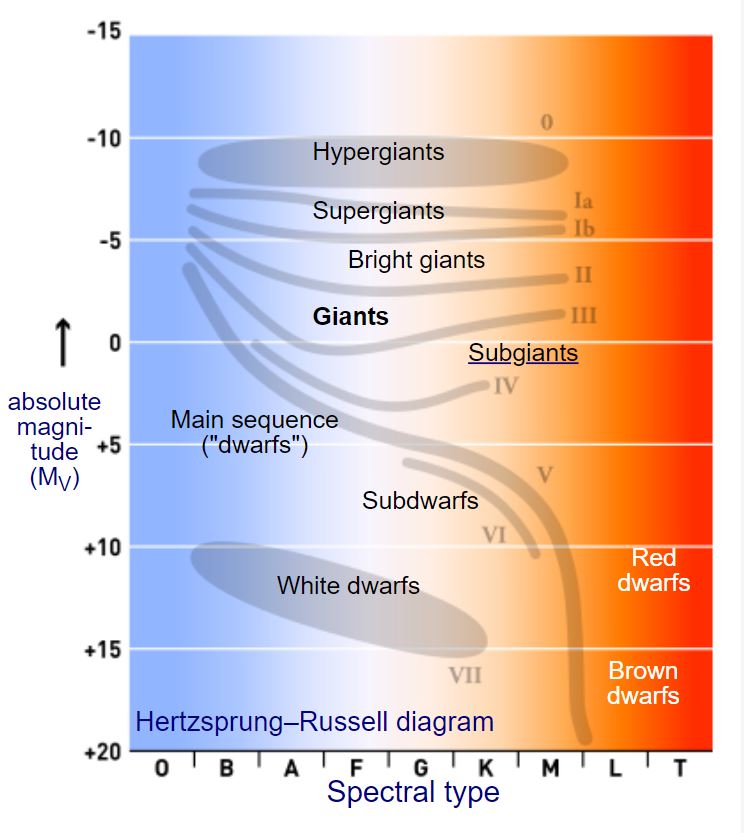
Refer Star Classification for further information about the diagram.
Subgiants can be seen above the main sequence stars in the HR diagram. These subgiants are brighter than a normal main-sequence star. They have absolute magnitudes between +2.5 and +4. They have class IV luminosity. When the main-sequence star ceases the hydrogen in its core, it starts to collapse in its own weight resulting in rise of temperature and begins to form a hydrogen shell outside the core. The stars which have low and intermediate mass start to expand and cool until 5,000 K. They begin to increase in luminosity reaching a stage known as the red-giant branch. Thus, the transition from a main-sequence star to a red giant branch is known as a subgiant branch.
Giant stars lie above main-sequence stars and subgiant stars. They are categorized as class III luminosity. Any hot, luminous main-sequence star can be referred to as a giant star. When helium in the core gets exhausted, a star with mass up to 8 Solar masses, degeneracy of carbon-oxygen in the core occurs and starts to burn helium in the shell. This increases their size and luminosity drastically. Thus, the main-sequence stars end up as a Giant star.
Bright giants have class II luminosity that simply is larger and more luminous than the Giant stars. They have their absolute magnitude as -3, which would be more brighter than Supergiant stars.
SUPERGIANT STARS: Now speaking about the topic, Supergiants are the most massive and most luminous stars. Their absolute magnitude falls between the rage of -3 and -8. The temperature of the supergiant stars vary from 3,400 K to over 20,000 K. These supergiants do not have a single structured definition. They are just enormously larger and more luminous than the bulk and thus the term super-giant arose termed as Supergiants. Higher the star’s luminosity rate, greater will be its mass-loss rates too. These luminosity rates are classified as Ib for supergiants, I1 for luminous supergiants and 0 or Ia+ for hypergiants. Since their mass-loss rate is higher, they burn faster and die sooner. And by death, Supergiants will end its life by exploding into a supernova. If the core remains, it becomes a neutron star. Or it simply becomes a Black hole with a sophisticated gravitational field where even light cannot escape.
Hypergiant stars are very rare types of star that have an extremely high luminosity, mass, size and even rate of mass-loss ratio. The main reason for which is due to their Stellar Winds. It has luminosity of Class 0 or Ia+ . Studies say that hypergiants are the newly evolved high mass stars formed from the main-sequence. Or it may be an evolved post-red giant star that has lost an enormous amount of initial mass.
These giant stellar objects are simply classified based on their luminosity and temperature. The stable stars are the ones that have High-mass with high a proportion of remaining hydrogen (i.e. the newborn stars). Whereas, less stable are the ones that have low-mass with higher proportion of heavy elements. These stars have a less stable atmosphere due to decreased gravitational attraction and increased radiation pressure.
 StarDustWaves
👍👍👍👍👍👍
LikeLiked by 1 person